Wednesday, April 28, 2010

11 Black Swans for 2010


1. China Blows Up
Andrew Lawrence proposed the Skyscraper Index in the aftermath of the 1998 Asian Contagion. His theory says that the world's tallest buildings have risen on the eve of economic downturns. That is, countries that put up the world's tallest buildings enter an economic downturn shortly thereafter.
There is a lot of evidence to back him up: 1907 panic in the U.S. was marked by the Singer Building; the Great Depression followed the Empire State Building; the Asian currency crisis of 1998 — the Petronas Twin Towers.
The world's tallest building at present is the Burj Dubai, which will officially open on January 4, 2010. As you know, real estate prices in Dubai have been cut in half and their biggest company, Dubai World, just defaulted on $50 billion.
The next tallest building being built is The Shanghai Tower in China — expected to be 2,073 feet tall to be completed in 2014.

2. The UK Defaults
High national debt, high inflation, high unemployment, plummeting housing prices, and a second round of bank failures coupled with political mismanagement sends the UK into insolvency. The Queen goes crown-in-hand to beg for money from the IMF.

3. No More Coal Plants
All new electric plants built in 2010 will be fired by natural gas. New drilling methods have increased the supply by 58%. Natural gas is clean, cheap, and it works. There is much money to be made in companies like Chicago Bridge and Iron (NYSE: CBI) that make transfer and storage facilities.

4. Uranium Surges to $90
The price of uranium launched in 2007 up to $145 a pound. Now, after the crash, it is back to $40 a pound. But the same demand that drove uranium up is still there. China is currently building eight nuclear power plants and has another twenty in the planning stages; Britain is building ten. Egypt, India, Sweden, South Korea, and most of Africa are building or seeking to build nuclear energy facilities.
The World Nuclear Association just had a meeting which concluded uranium demand is increasing and at the same time, previous production projections have dropped off due to the credit crisis. Companies like Cameco (NYSE: CCJ) will benefit.

5. Democrats Hold Their Congressional Majority
Strong economic performance in the second half of 2010 will drive down unemployment. The Democrats will be hailed as heroes who saved the economy. The average voter won't care about the new debt burden. And this — coupled with a schism in the Republican Party between the Old Guard and the Palin/Tea Party — will send the GOP into a leaderless chaos. Spending will continue to increase.

6. China Drops the Dollar Peg
After years of maintaining a link to the U.S. dollar to ensure cheap exports (and in the face of an ever-falling dollar), China pursues a strong yuan policy in order to buy up natural resources and create domestic consumption.

7. Iran Gets the Bomb and No One Cares
Much like Pakistan and India, Iran will build its nuclear warhead. Israel will be powerless to stop them due to the hidden, protected, and duplicate nature of the manufacture. The Obama Administration will send a strongly-worded letter in response.

8. The Housing Bust: Part II
Housing prices will take another hit as mortgage rates climb past 10%, the ARM balloon payments reset monthly mortgage payments for millions, banks finally sell their inventory, and a large portion of those who are underwater just stop paying. Expect another 30% drop in prices.

9. Dow Hits 20,000
No one is talking about an extended bull market, and I'll grant you that with the amount of debt the U.S. has taken on (on both personal and national levels), it seems the market's geared for a long up-move.
But consider this, dear reader: when Zimbabwe had run-away inflation in 2007, it also had the best performing stock market in the world. Take a look: 

Zimbabwe

According to Austrian Business Cycle Theory, the extreme volatility you see in the business cycle is not the natural state. Rather, it is one created by excess growth in money supply and credit.
New money is not simply given to everyone equally and at the same time... New money flows to certain entry points and filters out.
In this way, the money that is currently being produced by the Treasury and hoarded by the banks could flow to equities and launch another bubble.

10. Solar Power Goes Mainstream
Renewable energy will account for 15% of electricity by the end of the year — up from 12% this year. Wind energy grew 28% in 2009; it will grow even faster next year. A company that's looking good is J.A. Solar (NASDAQ: JASO).

11. Uncle Sam Officially Loses the War on Drugs
Four states — Massachusetts, California, New Hampshire, and Washington — seek to legalize marijuana. Currently in each state, there are bills being debated which will result in regulation and legalization of marijuana.
This new political will, coupled with a need to cut back in spending, will dramatically reduce the budget of the DEA as well as local police. One company in this growth business is Medical Marijuana, Inc. (MJNA.PK).

Look Beyond Precious Metals

It strikes me as odd that there's so much interest in gold-a substance that investors rarely, if ever, get to actually handle (at least in bullion form)-and so little in foodstuffs. You can live without gold-you can't without food.


Readers' eyeballs don't latch onto the stories that deal with agricultural commodities. Columns devoted to precious metals get the traffic.

Well, wake UP, folks. You're missing out on a big part of the inflation story-and the hedging opportunity-by skimming over the ag accounts.


Last week's Producer Price Index report showcased the impact of agricultural commodities on price inflation. You could say last week's numbers were the "meat-and-potatoes" of inflation. Well, meat and vegetables, to be more accurate. Fully 70 percent of the March hike in wholesale finished goods was attributable to food.
And a large part of that was due to soaring meat prices. We've examined livestock in previous columns ("Producer Prices Spike In March"; "Weekend Meat Musings,"; "Is Meat A Hard Asset?"). The parabolic rise in livestock prices, especially in lean hogs is setting up a massive short, but for now, the appetite for meat among consumers and investors remains unsated.


In the soft commodity sector, cotton's bull market gives no sign yet of relenting. After years of low prices and the ensuing switchover to more lucrative crops, global stocks remain tight. The supply situation could become precarious if there's bad weather in the U.S. cotton belt.

The kindling could have been lit with India's announcement of export restrictions last week. The ban followed a run-up in local prices due to tightening domestic supplies. Now, with the withdrawal of Indian stocks, buyers will have to compete more aggressively for U.S. and Chinese supplies. July cotton futures jumped a nickel a pound to the 86 cent level last week.


ICE/NYBOT Cotton (Jul. '10)


With prices clearing resistance at 84 cents-equivalent to a $40 share price for the iPath Dow Jones-UBS Cotton Total Return Subindex ETN (NYSE Arca: BAL)-the market's poised to challenge its decade-long record of 90 cents.


iPath DJ-UBS Cotton ETN (BAL)

      
And if the 90-cent level's taken out, you could see a parabolic move upward  like that exhibited in the live hog market. .

Better buy your polo shirts and other cotton summerwear now.

Friday, April 23, 2010

Things about Gold and Gold Mining Companies

1- Gold Bull Markets are short in time and Gold Bear Markets are much more longer in time. There are always exceptions, but this is the main rule

2- 90% of gold companies who are engaged in mining, processing & production, marketing and selling gold fund their operations using loans from banks and financial institutions

3- So, gold production is mainly financed using debt. And since bull markets are short and bear markets are longer, financing must be made when interest rates are at historic lows or low enough to justify injecting money into gold production

4- When interest rates start to rise, money starts to pull out and little investments are left over in the production proccess

5- When investors buy gold, they know that gold pays no interest and has no dividend to offer them, so they are mainly looking for price appreciation of the instrument itself. In most cases, it's very wise to buy gold or gold companies stocks when interest rates are at the lows, because that's the time where all gold companies start working and start making profits

6- The reason Gold prices and the US Dollar always go in opposite directions is that lower interest rates for the USD is always accompanied by declining stock prices, and people don't want to invest their money in the US stock market or even buy US bonds or open saving accounts,so they have 2 alternatives, either invest overseas, or invest in gold

7- Another reason, people think of gold as an insurance against any unwanted surprises. Many investors and funds use gold stocks as a portfolio hedge, increasing and decreasing the owned percent of gold stocks based on the interest rates and the overall performance of the US stock market

Thursday, April 22, 2010

Facebook Kicked Google Ass!


I’ve just watched the most shocking F.ree.
 If you’re marketing ANYTHING online 
at all, and you don’t do THIS…you’re 
sunk.
 
With 39 Billion page views per month, 
Facebook now accounts for 25% of ALL 
internet page views in the USA
 
[The Shocking Truth] 
 Trying to ignore Facebook is about as stupid 
as trying to ignore Google.  (ask Microsoft).  
 
In fact Google have publicly acknowledged
that Facebook is the only competition that 
they really fear and with good reason. 
 
The gurus have literally jumped on this and
If you choose to ignore it—well, I wish you 
a lot of luck  keeping back the tides of change 
that are sweeping over all of us.
 
[Watch This. You’ll Soon Understand]
  Normally I’m not quite this outspoken or 
harsh.
 
 But in this case, if you’re not using Facebook 
in your marketing, you're really are at serious 
risk of your business becoming a dim memory 
or going the way of the Model-T. 
 
Disclaimer: (antiques can be valuable) 
I’m not trying to be mysterious here ...
(well, maybe a LITTLE bit mysterious!). 
 
But if you are having trouble getting qualified 
prospects to your website…
 
If you’re having a heck of a time trying to 
afford your marketing…
 
If you would LOVE to have a stampede of 
traffic from Facebook to your business so 
fast it will make your head spin… 
 
[You’re Going To LOVE This!] 
 
You see, these two guys have so cracked 
the code on how to generate a ton-o-traffic 
and monetize the GOLDMINE  OF Facebook’s 
400 million users. 
 
It’s mind-boggling.  Even seasoned internet 
marketing gurus are?going to learn from them.
 
[Get The Facts Here] 
 
It’s a video. It doesn’t cost a dime to watch. 
 
You’ll get more astounding strategy, tips, and 
specific facts you can use immediately than 
from most of the products you PAY for. 
 
And it can truly change the path of your business.  
 
I don’t care if your business is already super 
successful or you’re just getting started.  


Tuesday, April 20, 2010

Businesses You Can Start at Home


Home-based businesses are proving to be a great solution for many women today, either as a part-time supplement to their familys income or as a full-time alternative to the 9-5 lifestyle. Could you be the next successful business owner? Consider the following service-oriented and product-oriented businesses.
If you opt for a service business, you can perform the service at home (word processing, tutoring, bookkeeping or child care) or at another location (interior design, home organizing or consulting).


Services that Sell

Computer Services

If you are technically proficient, a computer-related business might be right for you. Programmers, systems engineers, networking experts, repair and upgrade specialists, and web designers are always in demand. You could become a subcontractor for smaller companies and work as a consultant for them. Whether you provide software support or website design, the hourly wage for these services is among the best in freelancing.

Virtual assistant

Virtual assistants, or VAs, perform a variety of duties, ranging from answering phones to updating websites. Some read and respond to e-mails, type up transcripts, write articles and do light bookkeeping. According to The 2-Second Commute: Join the Exploding Ranks of Freelance Virtual Assistants, by Christine Durst, VAs are a $130 billion industry annually.


Bookkeeping

If your friends are always asking for help with their taxes, you can work down the street at a temporary tax store for $10 an hour, or you can sell your own services for several times that amount. You will need software and a computer dedicated to the business. Then you need to find clients. Look for small businesses that are just getting started; they're most likely to need immediate help.


Consulting/coaching/teaching

Providing consulting or coaching services is something many women can do. You start with your own expertise and specialized industry knowledge and sell it to people who need it. Lauri Meizler was a food-and-beverage analyst on Wall Street when she decided to become a nutritional consultant. Laureen Wishom did the same, leaving her corporate life to become a business coachfor women. There are consultants in every possible field you can imagine--from fertility to breastfeeding, weddings and nursery set-up. Many teachers and consultants leverage their time by teaching classes or consulting in groups.


Profitable Products

If you want to sell goods as your business, you'll have to decide whether to create them yourself (crafts, baked goods) or buy them from others and resell them (on places like eBay, half.comand Craigslist).


Online resale

You can sell or resell products via an online marketplace such as eBay, Amazon Auctionsor Craigslist. You can sell used goods, buy goods wholesale or use a drop-shipping service. Wendy, a nurse, has beenreselling yard-sale items for about two years.

"I started when I tried to resell my kid's toys at local consignment shops," says Wendy, who is preparing to shift to her resale business full-time next year. "They only offered about 30 percent of the retail price and, online, I could get closer to 80 percent. Now I buy items at yard sales for about 20 percent of their value," she says. She estimates last years earnings at $20,000 but is on track to double that this year.


Crafts

In September of 2008, when the stock market crashed and forecasts for most of the economy looked pretty bleak, Etsy.com, the handmade craft-selling site, reported a 5 percent increase over sales in August. In fact, just last month, more than 500,000 items sold, bringing in almost $8 million.

The possibilities are endless--you can turn your passion into profit if you are interested in any of these projects: art glass, basket weaving, beading, candle making, ceramics/polymer clay, crocheting, cross stitch, doll making, embroidery, fiber, floral, folk art, gift baskets, jewelry/lapidary, knitting, leather, metalsmithing, mosaic tiles, needlepoint, painting, paper crafts, photography, plastic canvas or pottery.


Agricultural/culinary providers

Resourceful growers specialize in niche markets overlooked by major farmers and ranchers, such as mushrooms, exotic fruits, organically grown vegetables or unusual plants and flowers. If you bake specialty items, you can sell locally to individuals, restaurants, businesses or farmers' markets.

The best home business idea is the one that fits your passions, interests, abilities and needs. Matching your resources with the perfect business idea is the best way to begin a new business designed to succeed
.
Lesley Spencer Pyle is the founder and president of Home Based Working Momsand HireMyMom.com, and she is the author ofThe Work-at-Home Workbook: Your Step-by-Step Guide on Selecting and Starting the Perfect Home Business for You. Pyle has been working from home for more than 13 years.

Monday, April 19, 2010

Gold, Black Gold and the Dollar

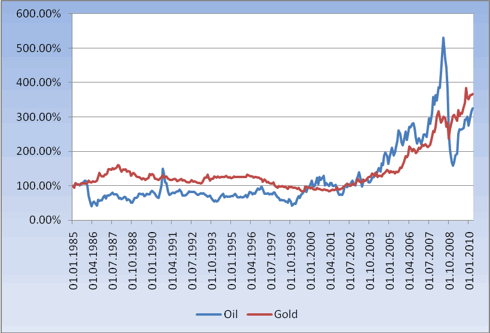
Although gold is no longer used as legal tender, it is still good at maintaining its purchasing capacity. The example of crude oil is quite illustrative.

The chart below shows fluctuations in dollar-denominated prices for crude oil and gold over the past 25 years.


Source: Reuters

As we can see, the upside is quite impressive. Interestingly enough, the exponential stage of growth began in the early 2000s, i.e. just at the time when Alan Greenspan’s soft monetary policy aimed at mitigating the consequences of the dot-com bubble began to produce an effect.

This policy also spawned a bubble on the real estate market, caused it to collapse and, eventually led to the much softer monetary policy which the Fed is currently pursuing. But let’s get back to the main issue.

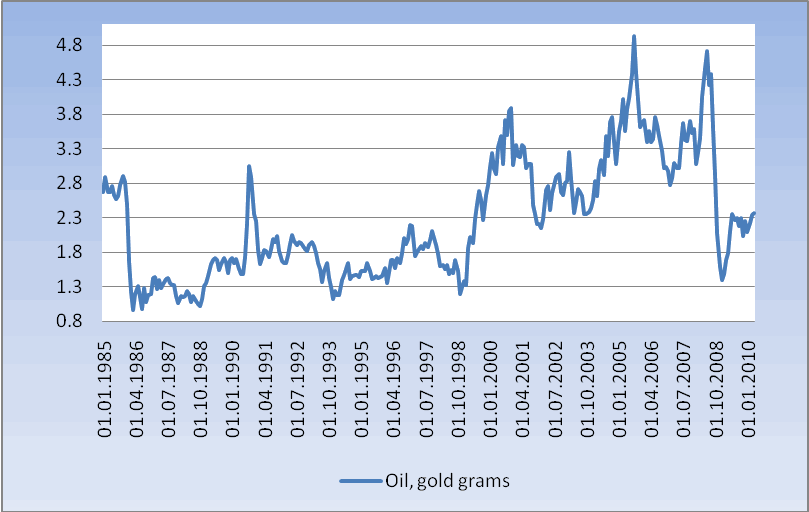
Now let’s take a look at the chart with crude oil prices where the per-barrel price is depicted as grams of gold.


Source: Reuters

It’s abundantly clear that crude oil now costs about 12% less than it did 25 years ago when priced in grams of gold. And even crude’s meteoric rise to an all-time high in 2008 does not look like anything out of the ordinary in this chart.

Although gold is often said to be quite useless in the modern economy, as the industrial use of this metal is extremely limited, gold is not edible, nor is it a good monetary policy tool. However, as practice shows, gold could turn out to be quite a valuable way for ordinary people trying to protect their savings against devaluation. Especially in the long-term outlook.

Sunday, April 18, 2010

Antique Coins and Gold Coin Collecting Tips and Tricks

Gold within the history of mankind has at all times been the measure of riches and opulence. Back in the beginning of recorded history, the chemical element of gold represented affluence. Mankind has at all times been charmed by this treasured coinage metal through the sporting of jewelry made from it, of treasured love through a golden marriage ring, or of wealth as shown by stories of gold bullion coin hoarded or appropriated.


Gold Collecting Nowadays

In the current day, gold is assumed by lots of specialists to be a secure investment decision amongst the confusing array of economic funding products. In the present day, the contemporary market stocks rise and fall in response to trade and industry predictions, firm efficacy, and international events. The hazards are usually excessive, so getting up to date buy bullion is your duty.

Only with gold can confine its heaviness by itself and its monetary value cannot be altered as to a great extent because the international events. One solution to do gold investing is to begin gold bullion coin accumulating. The worth of your compilation is decided on the coin’s state of preservation, the oldness and their distinctiveness. All-in-all, there are other specific financial profit to coin accumulating:


Inherent Value

Gold has historically been the in-pratice-though-not-by-law norm that reflects riches for the reason that beginning of time, and that is accurate both for the individual person, as well as the nations of the earth. The worth of gold is intrinsic in this treasured coinage metal as gold is still a key position as a part of the reserves held by centralized banks, nations and international firms such as the IMF.

Gold can’t be replicated or be manufactured by mankind as it’s a useful resource and often, when shares escalate and collapse, the cost and stability of a gold investment continues to be regular. What’s more, gold is durable and can’t be made nor can or not it’s shattered; due to this fact, collecting gold quarters is an interesting and positively safe and sound investment choice.


Fiscal Portfolio

So how do you have to determine your monetary portfolio? Obtaining a gold coin collection is fiscally indicated as being a trustworthy and sure investment choice. The very best part of this deal is that it’s without doubt manageable into rapid cash based mostly on its being legal money.

Again do observe that as with any other investment there are hazards depending on marketplace variables. However, ancient gold coins have always] been strong investment resources and have provided high-quality profits on the investment choice. Thus through gold bullion coin accumulating, you allow some diversity in your investment resources financial portfolio and it additionally provides a safety web through the historic and consistent worth placed on gold-based riches.


Tax Benefits

Can you believe it?

Gold coin accumulating really is a legal solution to put off your tax payment on your investment decision. What this means is that as your gain on this funding becomes heftier, your investment isn’t subjected to taxestill those cash are redistributed or put on the market. Solely then when those income are realized will they then be open to CGT.

Moreover, there are not any taxes imposed in case you desire to take your gold bullion coin accumulating to the extent of bartering or trading your assortment for an equivalent or greater valued ancient coin set. Gold coin accumulating shouldn’t be only a fun and fascinating hobby however it’s also a worthwhile one that may carry you abundant proceeds. However, you must do your investigation before you go on board on any commitment.

Are Gold And Silver Prices Ready To Make A Significant Move?


The perennial question that everyone wants to know is where gold and silver are headed in the immediate future.  The reality is that, for most people asking this question, the answer doesn’t really matter.  My potential customers thinking of buying or selling precious metals are normally making long term plans, where a small move in the market today won’t make a significant difference in the distant future.

However, sometimes gold and silver do quickly move up or down by a significant percentage.  Those who are thinking of trading would like to avoid buying just before prices tanked or selling before the big rise.
Very short term projections of price movements are treacherous because they are susceptible to a lot of unexpected influences.  Producing a ten year average price projection is far more likely to be accurate than, for instance, forecasting what the price will be exactly one year from now.

In the past two weeks, there has been much more than normal activity by the US government’s trading partners at adding to their short positions in the gold and silver markets.  Obviously someone, probably in the US government, has given the orders to restrain the recent price rises for the two metals.  It is evident that, for now, the limit for gold has been set at $1,160.00 and for silver at $18.50.  Should the metals get close to these levels and stay there for at least three days, such a trend increases the likelihood that prices will break out on the upside.

Since the prices of gold and silver have been pushing these targets at the close on Wednesday and Thursday this week, it was important to the US government that the prices be suppressed on Friday.  That is exactly what happened.

Of course, those who don’t accept the theory of the US government being behind the price suppression will point to yesterday’s announcement that the Securities and Exchange Commission filed fraud charges against Goldman Sachs as the reason for the decline.  This development resulted in a quick drop in US stock markets. 

With some investors receiving margin calls that they have to cover, other prices may suffer when investors have to liquidate other assets like gold and silver to get cash flow.  Also, John Paulson’s financial activities are linked to the charges against Goldman Sachs, which may create fear that Paulson’s recently created gold fund may have to sell some gold.


While this event is almost certainly having a significant impact on the decline in gold and silver prices, you have to understand the close relationship between Goldman Sachs and the US government.  Many who have held the position of Treasury Secretary formerly worked for Goldman Sachs. I have two suspicions here. 

First, with so many former Goldman Sachs officials currently holding high offices in Washington, I think that the company was not only aware of the forthcoming charges, but actually helped plan when the news hit the market.  Second, it is conceivable that this news development may have been timed to come out on a day when “something” was needed that would have the effect of knocking down gold and silver prices.

To me it is entirely possible that the charges against Goldman Sachs were deliberately released yesterday as part of the effort to attack gold and silver.  I have no proof of this but, when you consider the recent track record, to the US government this would be a sensible tactic.


However, I do not expect yesterday’s trend to last long.  My conclusion is of the “more likely than not” variety rather than a “virtually certain” one.  The factors supporting my thinking are not exact data that can be double checked or referenced.  Instead, they are more of collecting stories from people working various sectors of the precious metals markets, and trying to find a common thread among them.


The overwhelming direction of the stories I have been hearing focus on investors trying to purchase greater amounts of physical gold and silver but having greater difficulty at being able to do so.  There are also multiple horror stories about investors trying to take physical delivery on contracts and being thwarted entirely or at least having to wait months beyond the promised due date. 

The stories that may be most significant are those that suggest that some former allies in the gold and silver price suppression are now taking the opposite side to become buyers when the price declines offer temporary bargain buying opportunities.


Another reason I think the dip will be short-lived is the reaction of the public to suddenly lower prices yesterday afternoon.  My own company enjoyed its second highest sales day for silver in the past 30 years (as measured in US dollars)!  Our gold sales ranked among the top five sales days in the past 30 years!
Before the end of April, there will be some gold and silver price suppression when the current options expire.  Nonetheless, I think that, before the end of April, it is more likely than not for the price of gold to break its all-time record set in early December 2009.  I also anticipate that silver has a good chance to approach or exceed $20.


Patrick A. Heller owns Liberty Coin Service in Lansing, Michigan and writes "Liberty's Outlook," a monthly newsletter covering rare coins and precious metals. Past issues can be found online at http://www.libertycoinservice.com/ Pat Heller is also the gold market commentator for Numismatic News. Past columns online at http://numismaster.com/

Silver headed to $50 an ounce!

   
In the first 14 weeks of this year, the US mint reported that it has sold a total of 10,170,500 one ounce silver eagles, or 726,000 per week.  This is just shy of average weekly production of 742,000.
 
US Mint silver sales are about to overtake US 
production
Source: US Mint


Clearly, with the mint buying up the entire US silver supply there is a bit of a squeeze happening on the supply side. 

    Indeed, the main alternate source of storage, the silver ETF (NYSE: SLV), has been raided heavily over the past seven weeks.

    Since February 26, 17.9 million ounces -- or 2,557,000 per week -- have been withdrawn from the ETF by authorized participants.  Now withdrawing a tad over 6% of the silver out of SLV (it has 286.5 million ounces) may not sound like much.  But try putting it into this context:

    SLV accounts for around 50% of world silver inventory.

    Or, to put it another way, 3% of the world's silver inventory disappeared in just seven weeks!


    Another major reason for the squeeze is that government sales, which as recently as 2006 made up 8.6% of silver supply, have all but stopped (India, China and Russia used to be the largest sellers). 


    Now, with demand at around 900 million ounces a year, total inventory is around 8 months.  That ain't much given that industrial demand has risen by an average of 19.5 million ounces a year for the five years to 2008.  It has now risen from 38.5% of demand in 1999 to 50.3% in 2008.


Coin and Industrial demand are leading silver to a
 short 
squeeze
Source: The Silver Institute


    To cap it off, mining and scrap supply in 2008 was only 858.5 million ounces, creating a 40 million ounce shortfall. 
    Given that scrap supply is driven by recycled photographic paper, there isn't going to be any increase there. 
    And mine supply can take years to come on line, with a typical lead time between discovery and production of 8-10 years.
    If mine production keeps rising at the lethargic 2.2% it maintained for the nine years to 2008, there's no way in hell it's going to be able to keep up with demand. 
    That means the 40 million ounce shortfall is likely to rise even faster over the next 3-4 years towards 50-60 million.   

At that point, the silver ETFs will have been raided dry and the bullion banks are going to have a heck of a time convincing even the most naive politicians and bureaucrats that they are protecting their "silver holdings".

    The only way out for bullion banks is to let silver appreciate towards the traditional gold/silver ratio.  Over the past 15 years we've gotten used to a gold/silver ratio of 50-80.  But if you look back into history, the ratio was 37 in 1980, 32 in 1900, 15.5 in 1840, and averaged around 16 for the several hundred years before that.

    And 300 years ago, there wasn't a great deal of silver used in electronics.

    We're clearly headed back towards a gold/silver ratio of 30-40, and possibly more like 20 in the long term.  That would put silver at $50 an ounce in the hugely unlikely scenario that gold fell to $1,000 an stayed there.  

    That's hugely bullish for silver -- and it's where my money is going right now!


Market Crash! George Soros

George Soros, speaking at a meeting organized by The Economist, warns all those who are throwing their money into the equity pit, that "the financial world is on the wrong track and that we may be hurtling towards an even bigger boom and bust than in the credit crisis." Advice from Soros or from CNBC. You decide. Reuters reports that Soros said "the same strategy of borrowing and spending that had got us out of the Asian crisis could shunt us towards another crisis unless tough lessons are learned." We hope all those who are buying stocks have very tight stop loss triggers.
 
 
“The success in bailing out the system on the previous occasion led to a superbubble, except that in 2008 we used the same methods,” he told a meeting hosted by The Economist at the City of London’s modern and impressive Haberdashers’ Hall.

Unless we learn the lessons, that markets are inherently unstable and that stability needs to the objective of public policy, we are facing a yet larger bubble.
“We have added to the leverage by replacing private credit with sovereign credit and increasing national debt by a significant amount.”

The one thing allowing those invested to sleep at night is the observation that it took 10 years between the 1998 Asian crisis and the 2008 credit crisis. "If the pattern is repeated, it should at least mean we have another 8 years to go before the next crash."

We would take the under on that. In 1998 and all the way through

2008, developed countries as a percentage of their GDPs were at most half od where they are now. At this point the entire credit house of cards continues to exist only so long as credit conditions for US sovereign debt can be massaged by the Fed enough that the world forgets there are is $10 trillion in debt issuance on deck over the next decade (a conservative estimate).

It is a virtual impossibility that the money printer of even what may still be considered the reserve currency (although that distinction is rapidly shifting back to gold once again) can withhold a multi-trillion issuance onslaught and a multi-trillion corporate/CRE refi wave with 10 Years at under 4%. The next crisis will, as Soros points out, begin in the sovereign debt arena. In fact, it has already begun

Tuesday, April 13, 2010

Soros Says Greek Risk Remains After Aid Package

 Source: Bloomberg


Greece still faces the danger of a “death spiral” because the cost of borrowing in the euro region’s rescue package is too expensive, billionaire investor George Soros said.


“While it’s better than what the market is currently willing to offer, it’s still rather high,” Soros said at an event in London late yesterday organized by the Economist magazine. “It is a question of solvency. If you start charging very high rates as the market does in anticipation of solvency then that pushes you into insolvency.”
Euro region finance ministers on April 11 offered Greece a 30 billion-euro ($41 billion) aid package which would give it three-year loans at 5 percent if it can’t raise money in capital markets.

Greece auctioned Treasury bills yesterday for the first time since the rescue bid, drawing more demand than at a previous sale.

“Concessional rates” of borrowing aid would help Greece “fulfill their target,” Soros said. “If they don’t they have then to tighten even further, then your tax receipts go down and the economy goes further into tanking and then you go into a death spiral. That is the danger that is still remaining.”

Greek two-year government note yields were near the lowest in a week after yesterday’s bond auction. The yield on the securities had dropped as much as 45 basis points. It closed at 6.03 percent.

“The argument for political will to bail out Greece” was that “the consequences of Greece leaving the euro would be the disintegration of the euro,” Soros said. “The disintegration of the euro would take a very long way toward the disintegration of the European Union.

Soros Fund Management LLC manages about $25 billion. Soros said yesterday that “I’m no longer running the fund.”

The Europe Secret Weapon

The Weapon Called Bazooka
But Greece will only use the lifeline if a rescue becomes necessary. So they say...
(That should sound familiar to U.S. readers. Remember Hank Paulson and his financial bazooka?)
Back in mid-2008 — when he was selling Congress on unlimited bailouts for Freddie and Fannie — then Treasury Sec. Paulson said, "If you have a bazooka in your pocket and people know it, you probably won't have to use it."
We all know how that turned out. Pretty well — at least for Paulson's buddies. It let them keep dumping questionable loans onto the public's lap.
Meanwhile, Freddie and Fannie continue to hemorrhage billions and require government backing.
It looks like EU financiers are using a similar ploy to sell this bailout to their citizens. It's a lot easier to sell an expensive plan when it "may not be needed at all."
There's no doubt that Greece is going to need the cash. The question should be whether $61 billion will be enough.
All this does is buy Greece a little time. They now have three years to fix decades of systemic mismanagement, excess, and corruption... Three years to slash budget deficits from 12.9% this year — recently revised upward from 12.7% to 3% in 2012.
Probably not gonna happen. But it buys some time, which is typical of today's kick-the-can school of economics.
Morally Hazardous
Carten Brzeski, an ING economist who worked at the European Commission, summed up the situation: "All that fuss and talk about not putting taxpayer money at risk has been made obsolete."
It's true. Once you put a safety net in place, everybody gets more daring.
Now that the net is in place, EU members have an incentive to let their budgets get out of control. And until the EU puts something in place to discourage reckless spending, that's not going to change. Eventually, it could lead to a breakup of the EU... but that would be much further down the road.  
I mentioned that Spain and Portugal are licking their chops on this news. That's because they'll probably be next in line behind Greece for a bailout. If the Greek bailout goes through, other countries will expect similar treatment. It's a dangerous precedent... But it seems the world is full of those these days.
A Broken State
The Greek economy needs an overhaul (as do many others). Its public sector is bloated and government employees are overpaid.
What they're getting is short-sighted, extend-and-pretend economics. Three-year loans from the EU and IMF aren't going to save Greece; they'll just postpone any real change from taking place and allow the status quo to go on a bit longer.
The plan will inevitably lead to more bailouts in the future, for Greece and other EU member states.
It doesn't bode well for the European Union.
I'm with Jim Rogers on this one. Rogers' take on the situation is quite blunt: "Let Greece default, it'd be good for the EU."
Rogers has a point, though. It would send a message that European leaders are serious about maintaining budget discipline and countries better get their finances in order.
But that sort of market discipline doesn't happen these days, so we have to invest accordingly.
Are Greek Stocks a Buy?
The Greek bailout plan may be nothing more than economic voodoo. But that doesn't mean we shouldn't take advantage of it in the markets.
My colleague Christian DeHaemer lives for situations like the one unfolding in Greece right now. Chris is betting on the Bank of Greece. After all, we saw what happened to American banks after they got their $700b... Here's a recent note he sent out to Crisis and Opportunity subscribers:
The Eurozone Blasts Greece with Cash... Stocks Launch 
Over the past two days, the leading Greek bank, The National Bank of Greece (NYSE: NBG) has jumped 17%.
It moved on Friday as rumors hit the markets about a Euro/IMF bailout of Greece... Today — or rather, last night — the stock moved up another $0.45 cents to $4.07.
The European government offered below market interest rates around five percent to bail out a country that was running debt levels above 12% of GDP. The Eurozone will offer as much as 30 billion euros in three-year loans.
Bloomberg quoted former IMF economist Stephen Jen as saying, "This is more than a bazooka. They have gone nuclear on the issue of Greece. In the short run, the market is short Greek assets, so we'll get a rally in those."


Get Software to Butterfly Marketing for Free.

- Just register with your real email
- Download Instantly (No shipping)
- No Credit Card is needed
- No continuity options.
- No Long Video
- There is No catch.

Just enter your NAME and EMAIL to register and you get the software.

http://www.ButterflyOpenSourceCode.com

PLUS. . . (make sure to read)

* It is now open source
* you get PLR rights FREE (you can rebrand it and sell it.)
* You can keep all the profits
* You can use it on your own sites. As many as you want
* You can use it to build sites for others for a fee
* Comes with Free complete INSTALL Videos

http://www.ButterflyOpenSourceCode.com

Already "own" the software?

Well, even if you already have the Software or Home Study
course you do NOT have Private Label rights until you
register.


This is a good will promotion.

I am very serious about the new directions I am moving
my business and want to make the most of what got him
here available to the public at no charge.

This is an important and historic day for Internet Marketing.

Make sure to register now and see how the software can
EXPLODE your business. And it does NOT cost you a dime!

http://www.ButterflyOpenSourceCode.com