Monday, May 31, 2010

Gold - A Bubble but Not Yet & Why Warren Buffett is Wrong

First, full disclosure.  I am talking my book.  I own a lot of gold.  Since I have a large position, I am biased.  Always consider the position of the proponent when assessing the validity of the argument, me included.

Also be extremely aware that I may change my mind tomorrow and not tell you.  I own both gold ETFs and call options on gold ETFs.  If I feel that I am wrong or gold is rolling over, I may blow out my entire position.  Owing call options implies an element of timing.  I am not dogmatic and will sell everything if I think the market is turning against me.

Brett Arends had two articles in the Wall Street Journal last week.  The first article was on why gold probably has some ways to go.  I agree.
First, the recent rise [in gold] is deceptive. Yes, gold has risen from around $250 an ounce to $1,200. But that rise started at very depressed levels. Gold had been falling in price for two decades. In 2000-01, it was at the bottom of a very deep bear market. It had touched historic lows compared to consumer prices or other assets like shares. A lot of the past decade's boom has simply seen it recover toward longer-term averages.
Second, before we assume the gold bubble has hit its peak, let's see how it compares with the last two bubbles—the tech mania of the 1990s and the housing bubble that peaked in 2005-06.


The chart is below, and it's both an eye-opener and a spine-tingler.
Gold & other 
bubbles


It compares the rise in gold today with the rise of the Nasdaq in the 1990s and the Dow Jones index of home-building stocks in the 10 years leading up to 2005-06.
They look uncannily similar to me.

So far gold has followed the same path as the previous two bubbles. And if it continues along the same trajectory—a big if—gold today is only where the Nasdaq was in 1998 and housing in 2003.

In other words, just before those markets went into orbit.

Maybe the smart money is out of gold today. But how easily we forget that the smart money got out of these past bubbles way too early. The really smart money knows you make the most money in a bubble right at the end, when it goes manic.

In fact, the rise in gold looks fairly measured.  This is a logarithmic graph of the price of gold since 2001.  Gold has risen at a fairly steady rate in the nine-year bull market thus far.


Gold 01-10


The top of a bull market / bubble is usually marked by a final surge that explodes higher.  There have been times of frothiness in the gold bull market, but after mild corrections, the price has resumed it's upward trajectory.

Compare gold to the Nasdaq, which exploded higher in 1999 and topped in 2000.  This is a logarithmic of the Nasdaq from 1998 to the top in 2000.  The slope of the final move is steeper than the previous increases in the index.


Naz 98-00


If Arends's chart is a rough approximation of where gold is headed, it will top out at $2500 to $3000 within a few years.  On some measures of inflation, the real price of gold topped out around $2300 nearly 30 years, so a $2500-$3000 price target is not unrealistic.

Arends's second article was more critical of gold. 
In Part One of this series, when I argued that gold might be about to go vertical, I made a whole bunch of new friends among the gold bugs.
And now I'm going to lose them all.
That's because even though I think gold might be about to take off, I don't recommend you rush out and put all your money into gold bars or exchange-traded funds that hold bullion.
And this is for one simple reason: At some levels, gold, as an investment, is absolutely ridiculous.
Now I can respect someone who says that they will not invest in something they do not understand.  I stay away from biotechnology like the plague because I am utterly clueless about biotech.  I also agree that at some point, gold as an investment will become absolutely ridiculous.  There will be a time when you will want to be far, far away from gold. 

However, I disagree with Arends's premise regarding why gold is ridiculous as an investment.  He makes a mistake, I believe, many people make, including Warren Buffett, whom Arends quotes.
Warren Buffett put it well. "Gold gets dug out of the ground in Africa, or someplace," he said. "Then we melt it down, dig another hole, bury it again and pay people to stand around guarding it. It has no utility. [Emphasis added]  Anyone watching from Mars would be scratching their head."

Now, it is a rare occasion when I disagree with the world's greatest investor and richest man, but Buffett is making a fundamental mistake regarding utility.


Gold bears often argue that gold has no fundamental use or intrinsic value.  This is what Buffett implies in his argument - "We don't use it.  We just pay people to guard it.  What good is that?" 
Well, let us look at a product of one of Buffett's most famous investments, Coca-Cola. 
Buffett made a fortune in Coke. 

When he bought the stock decades ago, Buffett realized that Coca-Cola was a powerful and ubiquitous brand that had tremendous global appeal and, at the time, significant cost cutting opportunities.  Plus, the stock was dirt cheap.  Coke was the perfect Buffett investment.
But what is Coca-Cola?  It is flavored sugar-water.  It has no nutritional value. 

It makes you fat and it gives you diabetes.  It is loaded with caffeine.  Coke is bad for you.  It is unhealthy.  What "intrinsic value" does Coke have? 

Turns out, it has intrinsic value because it tastes good.  People like it.  From a health standpoint, nobody should ever drink a drop of Coca-Cola, but that does not matter.  We want it.  It appeals to people's tastes.

Fact is, most of what we consume is related to taste.  We do not need to own a big house or an expensive car or nice clothes.  We choose to do so.  Most stuff people buy is not necessary.  We buy most stuff because we like it.  We do not need to eat a restaurant.  We can make things at home.  We do not need to eat steak or drink wine.  We can find nourishment in cheaper foods.  Instead, we do so because we want to, because eating steak and drinking wine appeals to us.  We like it.


Most gold is consumed as jewelry.  Jewelry has utility because it is shiny and pretty and appeals to our tastes.  What intrinsic value does jewelry have other than we like it?  How is that any different from liking a good steak, a fine wine, a nice suit or a Coca-Cola? 


This is all utility.  Utility is the satisfaction something gives us.  We don't need to buy a steak, we can eat lentils and rice instead.  We don't need to end the day with a nice merlot, we can drink water.  We don't need to dress in nice clothes, cheap suits from Sears will do.  We don't need to drink Coke since we will probably live longer if we don't.  But eating steak, drinking wine, wearing nice clothes and craving Coke all gives us utility.  And we get the same utility from owning gold.


"Ah, Toro," you might be saying, "you are talking about jewelry, not gold as an investment.  What utility does gold as an investment give us?"  It gives us the same utility that property insurance or a home security system gives us - peace of mind.  It is money to protect us from the debasement of fiat currencies by governments.  And the debasement of fiat currencies has been occurring at an alarming pace for the past decade.


In his book, Money Mischief, Milton Friedman describes a society in the south Pacific whose money was giant limestone rocks at the bottom of the ocean that nobody had ever seen.  It did not matter that nobody had possession of or even had seen these rocks.  What mattered was the value assigned to those rocks.  The inhabitants used those unseen rocks as a medium of exchange and a store of value.  The submerged rocks were money because people believed they were money.  This unseen money had value, and thus utility, to Micronesians.


Gold is money because people believe it is money.  There is no doubt that gold is money, given the recent scramble to buy gold in Europe because of the Greek debt crisis.
Thus gold, indeed, does provide utility to its owners.  Gold is shiny and pretty and it appeals to our tastes.  And it is money. 


One final word - gold is in a bull market.  There are very few assets in the world today that are in a bull market.  Gold is one of them.

If you don't get it, fine, don't buy gold. You should never invest in anything you don't understand anyways.

But otherwise, don't overthink it.  Gold is in a bull market.  And it is much easier to make money in a bull market than in a bear market.

Options Trading: Selling Naked Puts

First, I want to remind you that you have only 1 day, until midnight tomorrow, Monday, May 31 to take advantage of the incredible stock options trading package I offered you a few days ago - scroll to the bottom of this letter to read the details.

Yesterday, I told you why I didn't like writing covered calls.  Yet there is a boatload of websites out there recommending that is exactly what you should do.

I could not find any website which advocated selling naked puts as an investment strategy.  Yet the truth of the matter is that selling naked puts has the same risk that writing covered calls does (and selling naked puts has some advantages that writing covered calls do not).

What would happen if you sold a naked put (i.e., without owning the stock)?  Most people would assume that such a move would be far more risky than writing a covered call.  It isnít however.  The risk is exactly the same.

If you sold a 60-day naked put (strike price $80 while the stock is at $80), and collected $4, you would gain exactly $4 if the stock goes up by any amount; exactly the same gain you would have enjoyed if you had bought the stock and written a call at the $80 strike.

LetÇs say that after two months, the stock has gone to $85, and you have earned a profit of the $4 you received from the sale of the put.   If you then sold an $85 60-day naked put when the stock was at $85, you might collect about $4.25.  Let's further assume the stock retreats back to the $80 it was when you started (if you recall, this is the same example we used yesterday when we discussed writing calls).

You would have to buy back the 85 put for $5 at expiration (the difference between the 85 strike price and the $80 stock price), losing $.75 on the transaction.  Since you earned $4.00 in the first period, and lost $.75 in the second, your net gain would be $3.25 for the four-month period. If you recall from yesterday's discussion, this is exactly the same gain you would have had if you had purchased the stock and written at-the-money calls.

The same phenomenon exists if the stock should tank.  Once the stock has fallen by the amount of the premium you gained by selling the put or call option, you would lose $100 for every $1 the stock falls in value.  The maximum possible loss in both scenarios is $80, the price of the stock (since it can't go below zero).

If the financial results are identical, what advantages could there be to selling naked puts over writing covered calls?  Many people who write covered calls do it on margin. They purchase the stock and borrow 50% from their broker.  Interest rates are low right now; surely lower than the 10% they might make in the above example (and considerably lower than the 30% they fantasize about but will never make).

Buying on margin allows them to almost double their return on investment, since with the original $8000 they needed to buy 100 shares of XYZ, they can now buy 200 shares on margin, and sell 2 calls worth $400 each. Clearly, buying on margin increases the return on investment as long as the stock stays flat or goes up.

Of course, if XYZ falls, the losses can be horrendous.  In the extreme case, if the stock falls 50%, you lose your entire investment.  Such is the nature of margin.

But covered call writers justify taking the extra risk of margin loans because they select stocks they feel good about; they are confident these stocks will not fall significantly in price.  (And probably, they are usually right, unless they are expert analysts, and then they could be terribly wrong).

How would the return on investment compare if you sold naked puts instead of borrowing on margin?  The maintenance requirement differs from broker to broker, but a typical requirement would be 20% of the value of the underlying stock.  In other words, if you sold a naked put on XYZ at $80, you would have to put up $16 per share.

Making $4 (less commissions and interest) on a $40 investment (margin loan and writing a call) is 10%, while making the same $4 (and taking the same risk) on a $16 investment (maintenance requirement and selling a naked put) is 25%.

And it gets even better.  There is no interest on the maintenance requirement, as there is on the margin loan.

Sometimes I wonder why there are dozens of websites advocating writing covered calls and none which I could find that recommend selling naked puts.  It must be that people feel more comfortable owning the stock.  Call it a warm fuzzy feeling that is both irrational and costly.

What is even better than selling naked puts?  My 10K Strategy, of course.  This strategy has made over 50% a year several times, in good years and bad, especially if the stock stays flat.  It involves buying long-term options (usually calls), and selling short-term options against them (being careful not to sell more options than you own).† 

How To Make $100,000 A Year With Ebooks!

My good friend Neil Asher has recently interviewed me, to
find out more about my "How To Make $100,000 A Year With
Ebooks" 4-step strategy.

You can listen to this interview, free of charge here:
http://getresponse.com/click.html?x=a62b&lc=oVWR&mc=m&s=GTwzu&y=o&

How Much Are You Making As An Affiliate?

Hope you're enjoying your weekend - just a quick question
for you today - How much are you making as an affiliate?

  If the answer is 'not enough', then it's time for you
to get the help you need to change that, right?

  I have been writing about Doug Champigny's Affiliate
Marketing PowerStart coaching class for a while the next
class starts on Wednesday at 8pm, and it's the last time the
8-week course will be available for the introductory rate
of $297 - when it starts back up in September the tuition
will be $497.

  So you can start now & be ready to rock & roll online
before September, or wait to take it in Sept & October
and shell out $200 more... Still well worth it for all
you'll learn & do, but why not get started 3 months
earlier for that much less? Enroll now at:

http://mypowerstart2010.com/affiliate

  You will get started this Wednesday night in your first
online class... After all, you want to up the ante before
the big fall season rolls around, right?

Reviews of Top Dog Trading

When you're thinking of getting a new trading course, the main
thing you want to know is - are people making money with it?

Most teachers will just show you a few hand-picked
testimonials they put on their web site.

So I've decided to do more than that ...

Here are links from some web sites where independent traders
go to post reviews of trading courses and tools that they buy.

These are not my sites and I have no control over them. To the
best of my knowledge they are independent and objective sites.
Check out these reviews of my trading courses for yourself on
the two sites below:

http://www.forexpeacearmy.com/public/review/www.topdogtrading.com

http://www.forexjustice.com/Review_Section/Forex_Education_Reviews/Top_Dog_Trading.html


Here's a site completely dedicated to product reviews. For full
disclosure I believe we have a material interest (it's been so long
ago I don't remember the details) but I believe we sent a free copy
of the course for review and the author became an affiliate of ours.

However there are a lot of independent reviews at the end of the
formal one where people have written in their own experiences:

http://www.tradingproductsreview.com/top-dog-trading-course-review.html

Monday, May 24, 2010

Warren Buffett's Secret Millionaire's Club


Warren Buffett has created a new online cartoon show to teach children about economics, saving, and investing. It's called "The Secret Millionaire's Club", and is about a group of kids who find and sell sports memorabilia worth millions to save their community center. An animated Buffett then helps the kids invest the money they have left over after saving the center.


Tuesday, May 18, 2010

11 Signs That The U.S. Government Has Become An Overgrown Monstrosity


Today, the number of Americans who are able to financially survive without any reliance on the U.S. government whatsoever is declining at a staggering rate.  Whether it is through direct handouts, entitlement programs, student loans, government bailouts, government contracts or direct employment, the truth is that now a solid majority of the American people are at least partially dependent on the federal government for their economic survival.  

The sad thing is that the majority of the American people say that there is too much government in their lives when opinion polls are taken, but if you try to take the government check that they are getting away from them those same people will scream bloody murder.

But the truth is that it is getting to be really, really hard to be completely independent of the U.S. government economically.  That is because the U.S. government has their hands in almost everything.  The ideal of a “limited federal government” has long since faded away.  Very few people seem to believe in it anymore.

Instead, Americans today look to the federal government as the answer to all of our problems, as the provider of all of our needs, and as the regulator of every single detail of our lives.
The U.S. government has become the “Big Mother” that we all scramble to for a handout when we get into trouble.

When you sit down and really analyze it, you quickly realize that there is no way that the U.S. government can be extricated from the U.S. economy now.  Instead of the free enterprise system that we once had in this country, today we have a situation where the U.S. government has become the very core of the economy.  It is the hub around which everything else in the economy revolves.
You don’t believe this?

The following are 11 signs that the U.S. government has become an overgrown monstrosity that almost every American is dependent upon for economic survival….


#1) The Explosion Of Government Handouts

39.68 million Americans are now on food stamps.  Millions of others are completely dependent on the extended unemployment benefits that they are receiving.  Millions of other Americans are able to survive financially because of the dozens of other welfare programs that the U.S. government subsidizes.  More Americans are receiving some form of welfare than ever before in history, and each month the numbers continue to go up.  Could there come a day when we all receive government handouts every month?


#2) The Entitlements Programs That Threaten To Destroy U.S. Government Finances

Entitlements are the single biggest U.S. government expense.  These programs include Social Security, Medicare, Medicaid and other social Ponzi schemes.  Tens of millions of Americans receive government assistance through these programs.  In fact, nearly 51 million Americans received $672 billion in Social Security benefits in 2009.  We all have friends or family members who receive these kinds of payments.  But cutting so many people a check year after year is slowly but surely destroying U.S. government finances.  

According to an official U.S. government report, rapidly growing interest costs on the national debt together with spending on major entitlement programs will absorb approximately 92 cents of every dollar of federal revenue by the year 2019.  That is before a penny is spent on anything else.  This is clearly not a sustainable financial situation by any definition, but who wants to tell tens of millions of Americans that their checks are going to be reduced?


#3) The U.S. Government Is Now Even Paying Mortgages

Yes, you read that right.  As part of the “stimulus” package, the U.S. government is going to send money to some of the states that were hit the hardest by the real estate crisis.  So what is that money going to be used for?  Well, Florida, Michigan, California and Arizona have all announced that they plan to use $1.4 billion the Obama administration is sending their way to help the unemployed and the “underwater” pay their mortgages.


#4) Without The Student Loan Program A Huge Percentage Of College Students Would Not Get An Education

The federal student loan program (which was recently entirely nationalized) helps millions of college students pay for their education.  Without this assistance by the government, a lot less students would be going to college.  In fact, many of you that are reading this article directly benefited from the federal student loan program.


#5) The Bailout Of AIG (AIG: 37.78 -1.22 -3.13%)
 
One of the biggest insurance companies in the world, AIG, would not be in existence today if not for direct federal government intervention.  It kind of makes you wonder what George Washington and Thomas Jefferson would think about a federal government that hands big bags of cash to a giant insurance company so that it can survive.  

Whether it was so they could pay off their debts to Goldman Sachs (GS: 137.36 -5.28 -3.70%) or whether it was so that they could keep paying out record-setting bonuses, the truth is that AIG would not have made it without the federal government stepping in.


#6) The “Too Big To Fail” Banks

But it wasn’t just AIG that got bailed out.  A number of big banks may have gone under if not for the U.S. government.  The U.S. government decided that they were “too big to fail”.  Well, what about all the small banks that are going under?  The truth is that they are “too small to bother with”.  We now live in a nation where the U.S. government is the one who decides which banks live and which banks die like dogs.  Doesn’t that just make you feel all warm and fuzzy?


#7) The Bailout Of General Motors
 
But not only does the federal government bail out financial institutions - it is also now in the car business.  Yes, grand old General Motors may have ended up on the scrap heap of history if not for the U.S. government stepping in.  So if you work for General Motors or if you work for any company that does business with General Motors, you can thank Uncle Sam for the fact that you still have a job.


#8) The Bailouts Of Fannie Mae (FNM: 0.98 -0.0195 -1.95%) and Freddie Mac (FRE: 1.35 +0.02 +1.50%)
 
If the U.S. government had not bailed out Fannie Mae and Freddie Mac, we may not have much of a mortgage industry at this point at all.  According to Inside Mortgage Finance, government-related entities backed 96.5% of all home loans during the first quarter of 2010, which was up from 90% in 2009.  So if you borrowed money to buy a home over the past couple of years, there is a very strong likelihood that the U.S. government was involved.


#9) The U.S. Government - The Nation’s Biggest Employer

According to the Bureau of Labor Statistics, approximately 2 million civilians work for the federal government, excluding the Postal Service.  When you add in all U.S. military personnel, that number goes much higher.

The truth is that as the government continues to expand (become more bloated), more Americans than ever are hopping aboard the gravy train.  Today, the average federal worker now earns about twice as much as the average worker in the private sector.  So if you want to do little work, produce little of real value and enjoy super cushy benefits, maybe you should apply for a job with the federal government too.

#10) Millions Of Americans Are Employed By Firms That Rely On Government Contracts


When considering the impact of the U.S. government on the economy, you can’t forget the hundreds of companies that would go out of business if their U.S. government contracts were taken away.  There are literally millions of people who work for companies that do business with the government.  If the government disappeared it would cause economic chaos for those firms.  The truth is that a whole lot of people make a really good living plugging into the sweetest revenue source of them all - the U.S. government.


#11) The U.S. Government Takeover Of The Health Care System


The U.S. government takeover of the health care system is going to fundamentally change the economics of the health care industry.  The U.S. government will now play a major role in deciding which hospitals get built and which do not.  Approximately 17% of U.S. GDP is spent on health care, and now the U.S. government has unprecedented control over where that money goes.  Over a dozen new taxes have been established by the new health care reform law, and the U.S. government is going to pour an unprecedented amount of money into the system.  So will this result in all of us getting better health care?  We’ll just have to wait and see.


The truth is that the Founding Fathers never envisioned a federal government that completely dominated that national economy.  But that is what we have got.  As of now, only a very small percentage of Americans are still able to say that they are completely financially independent of the U.S. government.


You see, in economic terms the U.S. government is not just the elephant in the room.  It is the elephant that sat on the room and nearly suffocated everything else out of existence.
As Americans, we live in an economy that is so intertwined with the government that it is impossible to separate the two anymore.

But the really bad news is that the U.S. government is in massive financial trouble.  According to one new report, the U.S. national debt will reach 100 percent of GDP by the year 2015.  Many economists regard that as an incredibly dangerous threshold to cross.

If U.S. government finances collapse, it will mean the collapse of the entire U.S. economy as well.  There is simply no separating the two.  And considering the fact that the U.S. government has piled up the biggest mountain of debt in the history of the world, things don’t look promising.


America is headed for an unprecedented economic collapse, and the U.S. government is leading the way.  If you can get financially independent, now is the time to try to do that, but the reality is that we will all feel massive economic pain when this thing comes crashing down.


Sunday, May 16, 2010

Japan is Going Down!

Over the course of this year in my Money and Markets columns I've presented some compelling reasons why the euro zone and the euro were in for a life threatening crisis. And despite the general consensus along the way that the problems in Greece were contained and that dips in the euro should be bought, I maintained that the euro was in a no-win situation.

Then last week, I suggested that because of the systemic threats represented by the PIIGS countries, Germany and the ECB had no choice but to go all-in to try to save the monetary union.
And last weekend, that's exactly what they did!

They went all-in, throwing massive funds and dangerous guarantees at the problems, and printing money to support it.


Make no mistake. This is not a bailout. A bailout implies that their response is a problem solver. Not so. Their response is a desperate attempt to stabilize what was clear to European officials ... a death spiral of the 11-year old European monetary union.
So what's next?

 
One thing is for certain: The sovereign debt crisis will not stop in its tracks.


With the rule book in Europe thrown out like last week's fish, the euro is in devaluation mode and so is the debt of all euro members. When it's all said and done, likely years from now, the euro may exist in name, but it will be composed of different members and different rules ... i.e. a new currency with an old name.


Now, the focus turns to the UK, the holder of the biggest budget deficit of the G-7 world and the most rapidly deteriorating debt load since the financial crisis of 2008 unraveled.

But I've already warned about the UK as the next wobbly domino.
Today, I want to go into more detail about the country that could prove to be the BIGGEST domino to fall ... with a gigantic global quake.


Japan, in Trouble ...


Take a look at the table below. Notice the aggressive growth of debt across nine advanced countries since the financial crisis and global recession set-in. Also notice which country holds the most government debt in the world. By far — it's Japan.


General Government Debt


In looking at this table, it's no secret how important it is for leadership in these countries to demonstrate a credible plan to reduce deficits and growing debt loads. All of which was a result of their massive policy responses to the near global depression.

The key word in the above paragraph is "credible." That's where Japan falls short.

The Bank of International Settlements (BIS) said in a recent report on the growing debt problems,
"As frightening as it is to consider public debt increasing to more than 100 percent of GDP, an even greater danger arises from a rapidly ageing population."
And within that statement are two of the three fundamentals in the Japanese economy that have it between a rock and a hard place, making a fix hard to imagine.


Fundamental Problem #1—
Declining Savings Rate


As I showed you earlier, Japan is approaching 200 percent of GDP ... double what the BIS considers frightening. Moreover the BIS projects, under its best case scenario, that debt could shoot up to more than 400 percent by 2040.


So how will Japan finance it?
Now, here's where Japan runs into trouble ...


Japan has historically been a nation of savers. The savings rate in the 80s and early 90s had been steadily over 10 percent, higher than any other developed country. That has allowed the Japanese government to sell nearly all of its bonds to its citizens and institutions ... to the tune of 94 percent of total outstanding public debt.


But since the economy in Japan went into stagnation in the 90s and given that interest rates for 15 years have hovered around zero, the savings attitudes in Japan have shifted. In fact, the savings rate is now lower than in the U.S. — a nation considered grossly addicted to spending, not saving.
Here's the chart on personal savings in Japan ...


General Government Debt


Now, look at the next chart, and you'll see ...


Fundamental Problem #2—
Declining Population


While savings rates have been declining, so has the population in Japan, putting more pressure on the absolute quantity of savings. And it's only expected to get worse. The projection for Japan's population shows a big fall over the coming decades due to its ageing demographic.


Population


And finally there's ...


Fundamental Problem #3—
Non-Competitive Interest Rates


With debt expected to keep growing and revenues and savings expected to decline, Japan will have to turn to the international markets to find buyers of its debt to keep its economy breathing.


But there's a problem with that scenario: Japan's interest rates don't remotely match the risk!


Japan's 10-year debt pays just 1.3 percent. Apparently that was enough for loyal Japanese investors. But that won't cut it for attracting international capital. Debt in other competitive advanced economies, like Europe and the U.S. are in the 3 percent to 4 percent range right now.
So what's Japan's ticket out?


A Currency and Debt Devaluation

As I said last week, financial crises and sovereign debt crises typically go hand in hand. As do sovereign debt crises and currency devaluations.


In a world where debt has grown dramatically across the globe and economies remain fragile and vulnerable, we're entering a period where countries will begin competing to weaken their currencies.
Europe is already underway by weakening the euro. The UK is likely next. And then, given the fundamental outlook I just laid out for you, Japan's yen could be in for a huge plunge.


As for the dollar, the U.S. faces all of the vulnerabilities from bloated debt and deficits. But in a world crisis, capital has to flow somewhere, and that will keep U.S. debt in demand ... and the dollar too.

Saturday, May 15, 2010

What's Tick?


The Tick can be used as a short-term indicator while day trading. Although it represents the number of stocks ticking up minus the number of stocks ticking down on the NYSE, it can be used as a barometer for stocks trading on all US Exchanges.


For example, if the Tick reads +200, then 200 more stocks on the NYSE are ticking up then are ticking down. This is obviously a bullish signal. If the Tick should read -354, then we understand that 354 more stocks are ticking down then are ticking up. This is a bearish signal. In addition to the actual "number" reading of the Tick, one should also pay attention to how the Tick is trading in relation to it's support and resistance. Be sure to watch it on a 5 or 15 minute chart in realtime. If you don't have access to realtime charts, you can take a look at these packages of stock trading software. The Tick also scrolls by during the "CNBC Market Summary" section of the CNBC ticker.

When the Tick remains positive on the day bullish momentum can continue. When the Tick remains negative, bearish momentum can continue. However, if the Tick should rise over +1000, the market will likely soon reverse because it has become over bought. The reverse is also true. If the Tick should fall below -1000, the market will likely reverse because it has become very oversold.


If you happen to be long when the Tick begins to rise over +1000 or short when the Tick begins to fall below -1000, you need to begin to lighten up on your positions or close them entirely in anticipation of a reversal.
To be extremly careful while trading, only enter longs when the Tick is above zero and shorts when the Tick is below zero.


What is Trin

The Trin is a breadth oscillator which aids in the measurement of internal market strength or weakness. Also known as The Arms Index (because it was invented by Richard Arms), the Trin is an acronym that stands for The Trading Index.

The Trin measures volatility within the stock market. The Trin represents the relationship between advancing and declining issues by measuring their volume flow. The Trin is commonly used as a short term trading tool.

The Trin also has an inverse relationship with the Tick. In contrast to the Tick, a rising Trin signals that the Bears are beginning to take control. Likewise, a falling Trin tells us that the Bulls are taking control of the direction of the market because a falling Trin shows us that more volume is flowing into advancing stocks than declining stocks.

The formula for the Trin is as follows:

Advancing Issues / Declining Issues
----------------------------------------------------
Advancing Volume / Declining Volume

This formula, like the Trin itself, helps us to descern whether volume is flowing into advancing or declining issues. The Trin will read under 1.0 when advancing stocks are the major source of volume and above 1.0 when declining stocks are the predominant source of volume flow in the market.

In Brief:
A rising Trin depicts a weak market and a falling Trin depicts a strong market.

Friday, May 14, 2010

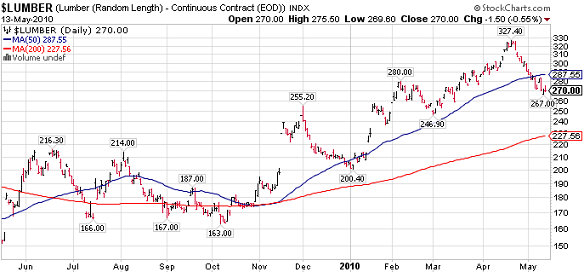
Lumber Prices Potentially down as U.S Housing Stimulus ends

Potential for weakness in lumber prices going forward as the housing stimulus ends and seasonality begins to turn bearish in the housing market. Lumber prices are 18% off their recent highs and still overbought after the sharp run-up on the back of the housing tax credit extension.


Like clockwork, however, prices have started to fall into and after the April 30th end of the tax credit. We’ve seen some signs of a potential continuing decline in the Shiller housing data. Are lumber prices leading the next leg down or is this just a dip in a continuing bull market?


lumber IS LUMBER 
FORECASTING THE NEXT LEG DOWN IN HOUSING?

Tuesday, May 11, 2010

NO Chance Of Double-Dip


The New York Federal Reserve updated its “Probability of U.S. Recession Predicted by Treasury Spread” today with data through April 2010, and the Fed’s recession probability forecast through April 2011 (see top chart above). The NY Fed’s model uses the spread between 10-year (3.85% in April) and 3-month Treasury rates (0.16% in April) to calculate the probability of a recession in the U.S. twelve months ahead (see details here).


The Fed’s model (data here) shows that the recession probability peaked during the October 2007 to April 2008 period at around 35-40%, and has been declining since then in almost every month. For April 2010, the recession probability is only 0.37% (about 1/3 of 1%) and by a year from now in April 2011 the recession probability is only .041%, the lowest reading since September 1993.


According to the NY Fed Treasury Spread model, the recession ended sometime in middle of 2009, and the chances of a double-dip recession through early 2011 are essentially zero.

Thursday, May 6, 2010

2 Commodities Are Set to Blast Higher in 2010


If you're looking for some calm during the market's ongoing storm, don't expect to find much in the commodities sector.
Not that this is a bad thing.


If you know what you're doing, commodities offer some of the most lucrative and potentially explosive profits anywhere in the investment world. And because simple supply and demand is the key driver for many of these everyday products, it's a sector ripe for volatility and speculation from hedge funds and large institutions.
Heck, you only have to look at the oil market to see that in action.
It's not uncommon to see prices cycle from highs to lows and back to highs again in a relatively short time. And it's this rapid-fire, rollercoaster movement that causes many would-be commodities investors to park themselves on the sidelines, rather than risk their cash.
But this is often a mistake - particularly since there are some quick and easy ways that investors can take advantage of the world's commodities. So let's see what 2010 has in store...
Why Oil Is Headed Back to $100
It wasn't long ago that oil prices blasted to all-time highs around $147 a barrel (July 2008, to be exact).
But they then set off on a remarkable decline that culminated with the price sinking to lows around the mid-$30 level by early 2009 - a full $115 or so lower than the record high, which equates to a staggering $115,000 move in equity on just one contract.
But as the chart below illustrates, oil has spent most of 2009 busily clawing back a sizeable chunk of the downward move - and I expect that trend to continue in 2010.

To see this chart in its original size, click here.
With momentum still on the bullish side, oil prices should continue to rise next year, due to the following factors...
  • Global oil demand is ticking higher.
  • Geopolitical issues are ongoing in the Middle East and oil-producing parts of Africa.
  • Oil is a great speculator's market - a fact that the massive amount of media attention helps to perpetuate.
In addition, the price of oil currently sits just above a major support level - the green 200-day moving average.
Right now, oil is still about $10 away from its high of $82 in October, but look for the price to test the $100 level again in 2010.
So how do you play the move?
Two Ways to Trade Rising Oil Prices
It's not as difficult or risky as some in the media would like you to believe. The easiest way to trade oil, aside from investing in individual oil stocks, is to go for the very popular and liquid, exchange-traded fund (ETF).
~ United States Oil (NYSE: USO): This trades like any other stock on the NYSE and gives investors a safer, cost-effective way to capitalize on the movement of oil prices. It also has options available.
If you're familiar with commodities trading, though, you can opt for this route...
~ Futures Options: You can trade oil directly through the futures, or futures options market on the floor of the NYMEX. But I suggest you steer clear of futures contracts and stick with limited-risk call option strategies.
The June 2010 options offer the best value right now, and whether you play them through the futures options market, or USO, it should give plenty of time for your directional prediction to play out.
But given the volatility of the oil market, if you have profits, take some money off the table.
Now onto the gold market...
Gold $2,000? How to Play New Highs for the Yellow Metal in 2010
They say a picture tells a thousand words, so just take a look at the chart below...

To see this chart in its original size, click here.
Having begun 2009 trading around $850 an ounce, gold has spent the year shooting higher. The frenetic run culminated with an all-time high of $1,218.
The reason is two-fold: The U.S. dollar's demoralizing decline, coupled with the weak state of the U.S. economy that has seen many investors flock to traditionally safer investments like gold. Mix in a hefty bout of bullish speculation and you've got the recipe for higher prices.
But with gold falling from that lofty perch over the past couple of weeks, we may well see plenty of investors trying to "buy on the dip" and take advantage of the next upward move. These are likely the same investors who believe the dollar will continue to languish, so expect to see gold set more new highs in 2010. Some analysts are even calling for gold to top $2,000 per ounce.
In the short-term, however, we could see gold continue to pull back to the 50-day moving average line just under $1,100. And if that line is breached, there is solid support at the 200-day moving average at $985.
If you want to take advantage of the pullback by buying gold on the current dip, there are a few ways to play your prediction...
~ SPDR Gold Trust (NYSE: GLD): Like USO for oil, GLD represents an easy, cost-effective, safer way for you to capitalize on the movement of gold prices. But if you want more leverage, you could buy call options on GLD. This allows you to put less money into the trade while potentially making a much larger percentage return than just buying shares of the ETF outright.
~ Gold Futures Options: If you want to go to the source, you can buy gold futures and/or gold futures options that trade on the COMEX in New York. But given the high risks associated with trading futures contracts, we recommend you stick with limited-risk call option trades instead. Go for option expiration dates at least six months in the future. June 2010 gold options are your best bet.


Wednesday, May 5, 2010

Why Great Traders Average Up, Not Down


If you walked into a department store and saw a fabulous cashmere sweater marked down from $375 to $199, you might be tempted to buy it.
And if you saw it priced at $99, you might feel you were getting an irresistible bargain. Perhaps you are.
But stocks are not sweaters.

A good trader doesn't average down - that is, buy more - as a stock plummets in price (although there is one exception to this rule, as I'll explain in a moment).

Whenever you see a stock that is plunging in a flat or rising market, it's a warning sign that something is wrong.


Why You Shouldn't Try to Catch a Falling Knife
You may not know what the problem is that is causing the stock to fall.
  • It could be that sales are down.
  • Perhaps the company has lost a major customer.
  • Expenses could be rising unexpectedly.
  • A new competitor has emerged and is taking market share, or driving down profit margins.


You may not know the reason for sure until the company makes some kind of public announcement. But by then, the stock could be substantially lower. Why do shares decline before any corporate announcement? Because bad news often filters into the market through customers, suppliers, employees, competitors, or analysts.
As a rule, a stock taking a swan-dive in a rising market is no blue light special. Averaging down on a losing position has the potential to leave a short-term trader throwing good money after bad.
Ask any shareholder of Lehman Brothers, Bear Stearns, or AIG.
However, there's an exception to this rule...

The One Time When You Should "Average Up"
The exception is when a company reports superb results - outstanding growth in both sales and earnings - but the broader market is declining.
When investors get scared or nervous and the market averages plunge - taking shares of healthy, growing companies down, too - that's the time to buy these companies on price weakness.
The Best Way to "Average Up"
This may go against every frugal bone in your body. After all, averaging up means increasing your average cost per share.
But it may also mean that you have a greater amount of money invested - and your final profits should be larger.
On your initial purchase, a good rule of thumb is to put in half the amount of money you intend to invest. After the stock rises 5%, put in another 25%. Assuming it rises another 5% - or approximately 10% from your initial entry point - invest the final 25%. Then run your trailing stop based on your average purchase price.
The advantage of this system is that you have less money invested in stocks that don't pan out. And more money invested in those that do.
Over time, this will be a big factor in determining your success as a trader.


Tuesday, May 4, 2010

The Biggest Online Winners And Losers For 2009: EBay Traffic Collapse

Some of the largest websites in the country had extraordinary swings in their audiences in 2009. Many of the most well-known web destinations lost large portions of their traffic

Based on data from Hitwise comparing US traffic market share from January to figures from November Ebay (NASDAQ:EBAY) lost 37% of its visitors. Craigslist lost 43% of its traffic, making it the largest loser among the top 25 sites. Neither number is surprising. Ebay’s earnings have been lackluster. Classified postings for apartments and jobs at Craigslist may have been hurt by the recession.


Other sites that had sharp drops in visits include Yahoo! (NASDAQ:YHOO), Yahoo! search, and News Corp’s (NYSE:NWS) MySpace all of which were down more than 20% during the measurement period. The MySpace figure is not surprising. The social network has been losing members to Facebook. Among the top 25 sites, Facebook has the largest gain, up 236%. The Yahoo! figures support data from other research firms covering search traffic. Yahoo! has been losing ground to Microsoft’s (NASDAQ:MSFT) Bing and Google (NASDAQ:GOOG). Google was the most visited of all sites measured by Hitwise and its traffic rose 7%.


Among the largest e-commerce sites, Wal-Mart (NYSE:WMT), the 2oth most visited site among all US destinations, had a 64% increase in visits compared to Amazon (NASDAQ:AMZN), the No. 15 site, which had a 26% increase. Wal-Mart and Amazon are locked in struggle for holiday shoppers and both have cut prices on popular items including e-books and DVDs. Visits to Target.com (NYSE:TGT) were 69% higher. Best Buy (NYSE:BBY) visits rose 23%.


Other notable increases among large sites were MSN, up 58% and YouTube which rose 109%, confirming the trend of improving visits to online video sites.

Sports sites did particularly well. Visits to ESPN.com were up 48%. Yahoo! Sports traffic rose 51%.
Very few people would be surprised by the site among the top 50 that gained the most. Visits to Twitter were up 559%.


Rank Websites Domain 9-Nov 9-Jan Rank-Jan2009 % Change
1 Google www.google.com 6.85% 6.42% 1 7%
2 Facebook www.facebook.com 6.47% 1.93% 5 236%
3 Yahoo! Mail mail.yahoo.com 3.95% 4.75% 2 -17%
4 Yahoo! www.yahoo.com 2.72% 3.52% 4 -23%
5 MySpace www.myspace.com 2.67% 3.53% 3 -24%
6 YouTube www.youtube.com 1.96% 0.94% 10 109%
7 MSN www.msn.com 1.76% 1.12% 9 58%
8 Windows Live Mail mail.live.com 1.71% 1.62% 6 5%
9 Yahoo! Search search.yahoo.com 1.24% 1.56% 8 -20%
10 eBay www.ebay.com 1.00% 1.58% 7 -37%
11 Bing www.bing.com 0.96% N/A DNR NA
12 Gmail www.gmail.com 0.91% 0.90% 11 1%
13 AOL www.aol.com 0.73% 0.27% 24 170%
14 AOL Mail mail.aol.com 0.58% 0.45% 14 28%
15 Amazon.com www.amazon.com 0.49% 0.39% 19 26%
16 Google Image Search images.google.com 0.49% 0.54% 12 -9%
17 My Yahoo! my.yahoo.com 0.48% 0.40% 17 18%
18 Wikipedia www.wikipedia.org 0.43% 0.52% 13 -19%
19 Yahoo! News news.yahoo.com 0.31% 0.38% 20 -20%
20 Walmart www.walmart.com 0.27% 0.17% 36 64%
21 Pogo www.pogo.com 0.25% 0.42% 16 -39%
22 Ask.com www.ask.com 0.25% 0.27% 23 -9%
23 Craig’s List www.craigslist.org 0.24% 0.43% 15 -43%
24 Google maps maps.google.com 0.23% 0.19% 32 22%
25 Bank of America Online Banking onlinebanking-nw.bankofamerica.com 0.22% 0.27% 25 -18%
26 Yahoo! Finance finance.yahoo.com 0.22% 0.27% 26 -19%
27 Tagged www.tagged.com 0.21% 0.14% 42 49%
28 Bank of America www.bankofamerica.com 0.20% 0.22% 27 -8%
29 Chase Online chaseonline.chase.com 0.18% 0.15% 41 24%
30 eBay Motors www.ebaymotors.com 0.17% 0.30% 21 -43%
31 Target www.target.com 0.16% 0.09% 62 69%
32 Yahoo! Address Book address.yahoo.com 0.16% 0.29% 22 -45%
33 MapQuest www.mapquest.com 0.16% 0.20% 31 -22%
34 ESPN www.espn.com 0.16% 0.11% 56 48%
35 PayPal www.paypal.com 0.15% 0.20% 30 -23%
36 Yahoo! Answers answers.yahoo.com 0.15% 0.14% 45 12%
37 Plentyoffish.com www.plentyoffish.com 0.15% 0.21% 29 -27%
38 MSNBC www.msnbc.com 0.15% 0.16% 37 -7%
39 Match.com www.match.com 0.15% 0.06% 95 135%
40 Twitter www.twitter.com 0.15% 0.02% 331 559%
41 CNN.com www.cnn.com 0.14% 0.18% 34 -20%
42 Chase Banking www.chase.com 0.13% 0.12% 52 8%
43 The Weather Channel – US www.weather.com 0.13% 0.18% 33 -28%
44 Google News news.google.com 0.13% 0.13% 50 1%
45 Yahoo! Sports sports.yahoo.com 0.12% 0.08% 74 51%
46 Wells Fargo – Online Banking online.wellsfargo.com 0.12% 0.15% 38 -24%
47 Yahoo! Profiles members.yahoo.com 0.12% 0.05% 132 140%
48 Google Video video.google.com 0.11% 0.05% 128 124%
49 Wells Fargo www.wellsfargo.com 0.11% 0.13% 49 -11%
50 Yahoo! Accounts edit.yahoo.com 0.11% 0.09% 71 28%
51 NetFlix.com www.netflix.com 0.11% 0.12% 53 -8%
52 AOL Search www.aolsearch.com 0.11% 0.08% 82 47%
53 Yahoo! Games games.yahoo.com 0.11% 0.14% 43 -23%
54 Singlesnet www.singlesnet.com 0.11% 0.21% 28 -49%
55 Yahoo! Sports – Fantasy Football football.fantasysports.yahoo.com 0.10% 0.01% 1463 1840%
56 The Internet Movie Database www.imdb.com 0.10% 0.13% 46 -27%
57 BestBuy www.bestbuy.com 0.10% 0.08% 79 23%
58 Fox News www.foxnews.com 0.10% 0.09% 63 2%
59 Photobucket www.photobucket.com 0.09% 0.15% 39 -38%
60 Wachovia Online Services onlineservices.wachovia.com 0.09% 0.11% 55 -13%