Thursday, June 24, 2010

"How A Former BANKRUPT Discovered The Breakthrough Strategies To Successful Options Trading And Now Makes Up To US$22,368.60 A Month From The Comfort Of His Own Home!"


Conrad Alvin Lim’s Journey: How A Former Bankrupt Now Consistently Makes Up To US$22,368.60 A Month Trading in the US Markets!

In 2001, I took the last big hit of my life when I became a bankrupt. It was the result of a string of events that led me to that point in my life. Looking back, I believe that all those events happened for a reason and that reason was to lead me to the point in my life in which I now stand.

I had decided to go into business for myself. The business was a resounding success and I had to cope with this growth. So I hired more staff and expanded within a year in anticipation of more business. I spent money I had not collected and didn’t have. I became more ambitious and grew ever more careless. I turned an ignorant eye to the basic rule of business (which I felt was someone else’s responsibility) and neglected my cash flow.

By the end of 1999, recession was evident again. My company’s debts ran high and I compounded my impending fate by personally guaranteeing on several large debts. By the year 2000, I could not afford to pay out salaries and my staffs walked out. I could not collect on some of the outstanding invoices owed to my company as these companies were also in dire straits and were about to wind up.

The realization of my failure brought on my first and only nervous breakdown and I had become suicidal. All  my so-called friends were nowhere to be found. It was the most traumatic experience I would never want to re-live.


Biting the Bullet & Declaring Bankruptcy

Finally, after listening to my wife’s advice, I decided to put my pride aside and took the painful decision to bite the bullet and to (gasp!) downgrade. We sold the car and took the bus. We squeezed into a three room flat and sold off our precious things that we didn’t have space for. We adjusted our lifestyle and prepared for a life of poverty.

Finally, she advised me to take bankruptcy as an option as opposed to a life in debt. It was the worst thing I could do but the best advise I ever had. Looking back, I would not be where I am today had I not been forced by my wife to swallow my pride and grovel for a living. And that is just what I did.


Picking up the Pieces and Starting All Over Again

I went back to my roots and picked up several books on design and taught myself how to edit video and audio. As I learnt this new skill, several old clients from the past kept faith in my abilities and kept a constant flow of work coming to help me out. I churned out the work from my humble home and ran my small freelance business with low or no cost. The wife, needless to say, became the breadwinner and sole motivation for my comeback.

One of the clients to bring a steady flow of work in for me was none other than my co-writer, Adam Khoo. I soon learnt, by producing a lot of Adam’s materials, the importance of self-belief and the power of a positive mindset. I learnt that while I could not change the past, my destiny was within my control. I thought very hard about my future and started to set the goal of not only paying back my debts & getting discharged from bankruptcy, but to become a millionaire.

The idea of being an investor grabbed my imagination. I spoke to my wife, Lucy, about it. I showed her the material I was working on and how easy and affordable it could be to become a full time trader. The promise of becoming a millionaire and improving the life of our family and our future generations, the dream of having a financially free lifestyle and the simplistic approach to the method was just too good to resist.


Experiencing Initial Failure…

After attending our first trading workshop in an intensive, mind-crunching four days, Lucy and I quickly funded our first account with US$5,000 and began trading. As luck would have it, profits came fast and easy and our account grew by 20% in our first week of trading. We then hit our first few losses and told ourselves that this was normal in trading.

The losses accumulated and still we lived in denial. Ignorance became a reality check when we wiped out almost all of our capital and whatever profits we had made. So we re-funded our account with another US$5,000 and tried again. I attended several more trading workshops and picked up more strategies. Still, the losses kept mounting.

We couldn’t figure out why, after paying so much for these workshops and working so hard to stick to the rules, we were still losing money. I began to wonder if the claims of making money from investing were nothing but a big pipe dream.

Our savings were running thin, my media work was getting affected and the workflow had slowed to accommodate my trading workshops and trading at night. My health took a dip because of the late trading hours. My marriage was strained and my family was getting affected by my mood swings and short-tempered flares. This was not how I dreamt it would be.  

Things had taken a turn for the worse and the dream was becoming a nightmare.


Learning from Mistakes & Changing My Strategy

After four months and over US$10,000 in losses, I stopped trading and took some time away from the market. A friend suggested that I read Alexander Elder’s books “Trading for a Living” and “Come Into My Trading Room”. That led me to pick up more books on investing and trading.


After reading these books and learning the true ins and outs of investing, I finally realized why I was losing money.

It was not that making consistent profits from the stock market was not possible. It was that the investing workshops I had attended had not adequately equipped us with the essential basics that were so necessary to an investor’s success.

The workshops did not teach us how to thoroughly analyze a company’s profitability and financial stability (known as fundamental analysis) as well as the essentials of understanding market psychology towards a stock (known as technical analysis).

Basically, the workshops run by many of these self-professed gurus gave just enough information for you to get all excited and kill yourself in the market.  

How on earth did I expect to pick up something in four days and believe that it would be so easy to accomplish something that others have taken years to build?


Getting Back to Investing Basics & Doing Whatever it Takes to Succeed

So I decided that I would do whatever it took to master the art of investing. I would first build a solid foundation by learning everything that needed to be learnt about investing in the stock market.

I hit the libraries, bookstores and Internet to suck out as much information as I could gather. I studied the finer points of Technical Analysis, Pattern Trading, Momentum Trading, Sector Investing and even Japanese Candlestick Analysis.

I got to know and modeled some real traders who gave valuable insights into the world of online trading. I started working out and running again and got my physical fitness back. With that, I got my self-esteem back up on the high.


US$50 a Day… Small but Consistent Profits

After three months of hard work and self-study, I was able to formulate a simple and affordable trading strategy which allowed me to consistently earn US$50 on single Options for every trade in less than five days. Soon enough, I was averaging US$300 a week with success in five out of every six trades. This first strategy that I had developed is known as the 5-Day Pre-Earnings Game.

This small but initial success gave me the confidence and motivation to learn even more and to work even harder. I began to learn and test more advanced strategies such as ‘Sector Rotation’, ‘Intra-Day Scalping’ and ‘Momentum Trading’, which you will learn in the chapters that follow.


Making US$5,000 – US$7,000 of Consistent Profits a Month

After more than a year of extremely hard work, I began consistently earning between US$5,000-US$7,000 a month in trading profits. And my earnings keep increasing as time goes by and my experience builds. In fact, I made US$7,000 within the first six trading days of the year (2007). By the end of January 2007, I took back a total of US$15,000 in profits.

After being a bankrupt for more than FIVE years (since 2001), I finally made enough money to pay off all my debts and applied to my official assignee to be discharged from bankruptcy. That moment was one of the sweetest memories in my mind.

Making US$22,368.60 In One Month!


Wednesday, June 16, 2010

Watch Over My Shoulder As I Show You How To Turn $2000 into $1.7 Million Dollars in Roughly 1.9 Years Trading Stocks...

My name is Anthony Green. My company is located at 207 West 56th Street, New York, NY. I think you may want to call me as soon as finish reading this letter... If so, my number is (646) 414-4638.
Now what I am about to share with you is a real life story.

It's about a very small team of 6 people (including me) who make an average of $153,846.17 each and every week... by trading on the stock market

And just to save you the math, that adds up to a little over $8,000,000 a year. Or just under $22,000 a day. In other words, it's a truckload of money -- no matter how you look at it!
But much MORE important..

I am also going to reveal to you how you can easily duplicate our system and make at least $100,000+ in your very first year of trading!"

So that, by the time you finish reading this page, you can get started TODAY and make some serious amount of cash trading stocks without any technical knowledge or any previous stock market experience.

In fact, if you just follow my technique, then I guarantee you will be able to turn...

$1000 into $1 Million in roughly 5 years.
Or $2000 into $1.7 Million in just 1.9 years!


And I also promise you that there is absolutely no technical analysis involved. You don't need to spend hours reading charts, doing technical analysis and stuff like that.
I guarantee that this is by far the easiest way to make money from the stock market. No matter how you see it...

Picture yourself, sitting in front of your computer on a Monday morning. The stock market opens in 20 minutes and you turn on your PC.

You follow 5 simple steps explained in the book. Within 10 minutes, you have found a stock trade that is bound to make you money in any market condition...

Go make coffee. Have a little breakfast. And wait for the market to open...
Call your broker to place an order or login to your online brokerage account and place the order yourself.
That's it...Your job is done for today.

The More Money You Begin With, The Less
Time You'll Take To Earn $1 Million Dollars!


Trust me, there are literally hundreds of ordinary people just like you, who are virtually shoveling incredible amounts of money from the comfort of their own homes by spending about 20 minutes a day and follow my step-by-step stock trading method.

And once again, there is no chart reading or boring technical analysis involved in the entire trade process.

In fact...

Even a 10 year old kid can understand it in 30 minutes and implement it instantly after reading this book - That's my promise to you.

How I Invented This formula
And Why Is It So Profitable?


It all begins with a question - what did I do right?

Ask yourself this question and you will, more often than not, be led before a path for success inaccessible by asking "What did I do wrong?"

I am like you: I read all the books, absorbed every system of trading.

And I tried them, too. This included everything from sedate long-term value investing (Warren Buffet-style) to impulsive and fast-paced day trading.

I made money sometimes, but mostly watched as the long term stock picks lost value, then regained it, only to lose it again in a nauseating roller coaster ride.

And day trading - glued to a newswire in the hopes of swooping upon an opportunity before others do proved more difficult than I expected when interpreting news stories and trying to determine whether that story had already been "priced-into" the stock, came into play.

But about three years ago, while still in the process of feeling around for an investment strategy that offered safe, consistent, yet considerable returns, I one day happened upon something quite extraordinary.

I made money on a stock.

Ok, nothing special about that, true enough. I'd made money and lost money, and according to the amalgamation of theories offered forth by the myriad stock market gurus it was simply important to make more than you lost, right?

But as a lover of mysteries, particularly Sherlock Holmes, I decided to deviate from my typical "What did I do wrong?" approach reserved for mistakes and investigate the opposite: What did I do right this time?

So that is what I asked myself the day that I saw a stock I had purchased virtually at random climb significantly the day after I bought it.

And the answer to that question changed the way I traded stocks from then on.

Exciting Discovery: Ultra-Short
Term Value Investing


Each stock market investor has what he or she deems to be the best method for success... or in some cases, unfortunately, failure. I am no different.

If you are reading this page, then you have at least some desire to actually make money in the stock market, whether your current strategy has been "Buy and Hold", "Buy Low, Sell High" (!), or "Day Trading".
Notice I placed day trading in quotes. That is because I am now of an opinion that nowhere has a more laughable, emotionalist mentality been applied to the system of stock picking than is practiced by the majority of today's day traders. I know. I was one of them.

If you have doubts about whether yet another stock trading strategy can benefit you, then congratulations. You have all the rationality and sense you need to actually stop searching for one and begin using one that works.

If that describes you, read on. You have nothing to lose; this page is not long, it will not appropriate very much of your time. And along the way, be prepared for a discovery that will surprise you, the skeptic, most of all.

Also, be assured my system does not involve Technical Analysis, no Fibonacci Curves, no Bollinger Bands, none of that. It does not have anything to do with attempting to predict the future movement of a stock based on its past movements at all.

In fact, you could actually label my system Ultra-Short-Term Value Investing, though that might be a little cumbersome (and more than a little silly).

So back to that profitable stock. What company was it, you ask? Oh, I think it was Best Buy or Home Depot, honestly I don't remember. Because it doesn't matter.


The conditions that made that stock ripe for buying then may or may not exist any more, anyway. The important thing to ask was a new mental query in my head that was formulated something like this:

Did that stock rise suddenly on that day for a
predictable reason, can such a trade be repeated, and if so,
can it be repeated with foresight, safety, and regularity?

Now, mind you, that is the plainly drawn anecdotal version of a thought process that led to much research, that in turn led to the following answer: Yes.

Another Discovery: 6 Step Formula
A Holy Grail of Trading :)


I continued researching on the technique. I wanted to device a step by step formula that does not require any technical analysis or complex mathematical theorems. But at the same time, should not take more than 15 minutes of research.

And finally, that system could accurately predict exactly what stocks were about to rocket in price.
You see... I wanted to make sure that when stocks pass through all 6 steps in the formula, they almost always rise... Usually within hours and they are extremely safe trades.
Just enough to...

Siphon Off $200, $300 or $500 a Time


And after 9 months of intensive research, me and my team was able to designed a system that does exactly what we were looking for. In fact, we were able to bypass one out of 6 required steps. So now we have...

Instead of 6, We Now Have 5 Steps To Follow!


As a matter of fact, the greatest feature about this trading system is that you can start trading with as little as $1000 into your trading account.

If the unthinkable happened and you lost it, you can decide that, well, it is after all only one thousand dollars. You can always earn it again.

If you find that attitude unthinkable, then you have no business buying stocks using anyone's strategy. The market is risky no matter how you invest.

There's one more thing I'd like to share with you...

If you have more money to invest in the stock market, let's say, $5000 or $10,000, then you can achive your target of $1 Million dollars in much lesser time. Which means...


Five important things that you don't need to make money from the stock market:


You don't need money- In fact, you can practically get started with as little as $1,000 and can still make 1 million in 5 years or less. Increase your initial amount and you can achieve the target of 1 Million in much lesser time.
Don't waste your time doing unnecessary research- Say goodbye to complex theories, charts & boring technical analysis. All we want is 10 minutes a day to follow 5 simple steps explained in the book with the help of examples, pictures and graphs.
You don't need any prior knowledge or technical skills- Again this always helps, but you don't need it to succeed. All you need is the willingness to learn and follow our sure-shot stock strategy. Because after all this is for the struggling stock traders.
You don't need to pay for any software, subscrition etc.- There is absolutely no need to waste your hard earned money on any other expensive subscriptions, tips, books, systems, seminars etc. This book will cover everything.
You don't need to pay me if you don't make money- Your order is backed by a 56 days, 100% money back guarantee. So if, for some reason, you find you're not entirely satisfied with your decision, you can ask for the refund.


Step By Step With The Help Of Pictures, Examples & Whatever Is Required To Make You Understand!


THIS IS NOT a major hoops to jump through concept which looks good on paper but impossible to apply. The entire concept is explained in detail with the help of pictures, graphs and examples to make the entire learning a lot easier.

This stock market ebook is suitable for beginners as well as experienced traders. Both of them can take advantage of that.

But before I tell you how you could get my secret trading formula... Let me explain...


Why you are so close to financial
freedom ... and yet so very far.


When I sat in your seat, feeling what you feel, I truly believed I was years away from success. Perhaps even decades. How could it be any other way? But the truth may surprise you.

Right now, at this moment... you are probably one step away from success. Because, one successful technique is all it takes: you are so close... remember, it all happened for me once.

A single decision can separate the winners from the losers. Travelling the world and seeing it with my own eyes has taught me that. Because... me and my team makes over 153,846.17 per week. And some make a great deal more.

I have students from India, Australia, Canada, USA, Pakistan, China, New Zealand, Italy... You name it.

And if you read those testimonials, you'll find out that many people have practically no money to get started.

This is the only stock market strategy in the world that teaches you how to make money from the stock market even if you start with just $1000 dollars.


But don't be confused:

This is not a "magic pill" you take and suddenly you're rich. Trading is not a get-rich quick scheme. It takes time to earn money and become successful.

And if you're dreaming that you will double your money every few weeks and start dating Hollywood movie stars with your newly found wealth, then I must remind you that you're wasting your time reading this letter.

You can go back to praying one of those "magic pill" schemes start to magically work. This EBook will reveal a sure-shot method to make money from the stock trading easily and safely. But I want to see a level of consistency and determination in you.

You are standing right in front of a vast,
limitless mountain of checks - only you can't
see them, and you never will...


The purpose of this letter is to show you where to look. Exactly where to turn, to ensure they are staring you in the face. And how to grab as many as you can, while you still have the chance to do it.
This is my reality. And while you probably feel that it is impossible, the truth is,... it's so real, and it's happening every day.

And, remember, I talk from experience. I came, saw and took what was rightfully mine. Believe it or not: the money is there and will stay there for years to come.. at least, for the few who know where to look.
And while the gap between me and you might be immeasurable in some ways, you should never forget: you have this one chance to join me, to copy me. And the transition might be far quicker than you had ever imagined, provided that you have the heart to follow my lead...

Truthfully, you would never have guessed any of this unless I told you. Right now, it probably feels like you could never achieve your goals. And the way you are going, I must admit it... you are probably right.

There is only way for you to accomplish your goals: you need access to underground, raw techniques that until now have never seen the light of day. Techniques that are literally illegal in some cases. Like I said, the truth is never easy to stomach...

In short, you need proven methods and unreleased techniques that run contrary to what you have been drip-fed by the gurus. You need to abandon the "old school" methods and test-drive my underground secrets while the opportunity is still here.

And if you think all this sounds too good to be true, that's because... it is.

Is This Working For Other People?


Over 263,000 people in 154 countries have already used the program successfully over the past 4 years! And I've used the feedback from all of those users to refine the program into the current updated 2009 version, which is more powerful than ever.

As a matter of fact, I had my technical assistant use our database of customer zip codes to plot a map of all of my readers in the US alone...SEE BELOW!

Keep in mind this is only a map of my US-based readers, since the address data for all of my international readers couldn't be plotted by our map software.

Map showing "Secrets of Successful Traders" Readers
plotted with mapping software -- zip code data.


As you can see, this map displays all of the readers of the Secrets of Successful Traders in the US alone. All total, I've had over 263,000 users in 154 countries to date. 


Not only that, but my program has one of the lowest refund rates in the entire stock market industry:
97.1% of "Secrets of Successful Traders" readers are satisfied with the program, while only 2.9% have refunded the program.


These reader satisfaction statistics prove that if you apply the info in this program, you WILL get results... plain and simple!

Thousands of people who have read this eBook have changed their destiny. I get countless emails everyday in my mailbox from users around the world about this one of a kind ebook just this from Bill Pearsall, Fl -

You will be given access to the most advanced strategy that are backed with an award winning support staff. We will help you every step of the way.

I don't live in USA. Can I still use you trading strategy?


Absolutely Yes.

It doesn't matter which part of the world you belong to, you can apply our sure-shot strategy and can make money from the stock market. I have students from India, Australia, Canada, USA, Pakistan, China, New Zealand, Italy... You name it.

Hi Anthony,
I don't know about anybody else but this book has really given a new platform to my trading and just I can't thank you enough for it.
This is one of best book I've ever pruchased. I'm amazed by the amount of information you're providing in this book. I can confidently now say that this book can teach anybody how to make money from the stock investing. Best wishes,
William Rhodes


Newbie Or Experienced... It Really Doesn't Matter.
Either Way, I'm Going To Help You Make 1.7 Million
In Roughly 1.9 Years.


I wasted $1500-$2500 before buying your EBook, Now I've $26,500 in my account which is growing every single day
Hi Anthony,
Just wanted to say THANK YOU...
Today with the help of your ebook "Secrets of Successful Traders", I'm making money from the stock trading faster than ever. And it's not a long term investment. I mean, the more frequent you are, more money you can make...And I love this.
I checked my account last week and I've over $26,000 in it which is incredible...I was not expecting an extremely simple stock market strategy could do this.
Before buying your investing ebook, I had spent several thousand dollars trying to find a reliable system in which I can trust blindly (all wasted)...
...But I think now I've just found one.
My sincere thanks...
Fernando Cruz

Unconditional 100% Money Back Guarantee


Try the program out for a full 56 days, that'll give you a more than 40 stock trading days to paper trade the system and prove to yourself in real time that this system really does work!

Do the calculations monitor the trades, if we have not delivered everything we promised and more, then I insist you email us and we will refund 100% of your purchase price. That's right, 100%.

Plus A Never Seen Before $200 Cash Back Guarantee


In addition to a basic refund policy, I also offer a $200 guarantee so if you try the formula and find it doesn't work as intended, I'll give you $200 from my pocket.

It's as simple as that! Plus, you can keep the entire package-even if you ask for a refund!


Why would I make such a one-sided guarantee in your favor?


Well, the truth is I'm not really worried about refunds because I've seen how people making massive amount of money using my strategy. In fact, I personally have been using the same free stock trading tips over the years and making money from the stock.

I am confident, once you get your hands on this information and see the incredible potential, you'd have to be almost insane to return it. I can't possibly be any fairer than that.

Over a 30 day period, that's only $2.33/day, less than you'd spend on your daily latte. That's not even comparable to the $20 commission you pay to your broker every time you trade.

I guarantee the money you will earn following my fail proof method of stock market trading can easily pay you back hundreds (or even thousands) times your investment.


ORDER NOW USING THE FORM BELOW!


Monday, June 14, 2010

Bubbles Blowing

Let's face it; central banks are blowing another asset bubble. As if two burst bubbles in the prior decade are not enough, the money maestros have decided to fuel another speculative orgy.

Let there be no doubt, both the technology and real estate bubbles were spawned by cheap credit and it is now clear that the central banks have learned nothing from those two episodes. Despite the fact that near- zero interest-rates caused the previous mishaps, the central banks are (once again) pursuing a suicidal monetary policy. By keeping interest- rates well below the rate of inflation, the officials are encouraging speculation, thereby sowing the seeds of yet another asset bubble.

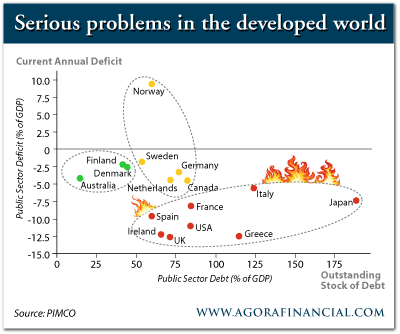
At present, the yield curve is steep in most nations and the cost of borrowing is low, so is it any surprise that asset markets are rallying? All over the world, asset prices are inflating again and dangerous excesses are around the corner. Only this time around, the public sector in the West is already over-leveraged and when the next asset bubble bursts, governments will not be able to come to the rescue.

Today, most of the developed world is drowning in debt and various industrialised nations face severe deficits. Moreover, these over- indebted economies are struggling to grow, therefore it is highly unlikely that their stock markets will provide leadership.


Global Deficits

Now, given the fact that the developing world is growing much more rapidly, it is highly probable that the emerging market equities will benefit the most from asset inflation.

Apart from sporting superior growth rates, it is worth noting that the developing nations have relatively low debt levels. It is our contention that this combination of strong economic growth and compressed leverage will be sure to catch investors' attention.

The next chart highlights the huge discrepancy between the fiscal health of the industrialised and developing nations. As you can see, public debt relative to the economy is already very high and likely to surge in the developed world, whereas this ratio is expected to decline in the developing world. Therefore, over the next decade, we can expect more and more investors to shift their capital from the debt plagued developed nations to the healthy developing economies.

Developed vs. Emerging Markets

Historically, the developing markets have traded at a valuation discount when compared the developed markets. However, over the coming years, we suspect that the 'risky' developing markets will command a valuation premium relative to the industrialised world. Put simply, when you factor future earnings growth and an expansion in valuations, the developing markets are prime candidates for the next asset bubble.

Since the turn of the millennium, we have favoured the developing countries in Asia and we continue to like China, India and Vietnam. In our view, these economies will prosper for different reasons and their stock markets will reward long-term investors. Now, there can be no doubt that both China and Vietnam have been disappointing over the past few months, but we view the ongoing consolidation as a fabulous buying opportunity.

In addition to the developing nations in Asia, we believe the energy sector is also a worthy candidate for the next asset bubble. In fact, when the realities of 'Peak Oil' dawn in investors' minds, we could witness an outright mania in conventional and alternative energy stocks.

Although we recognise that the developed world faces some serious economic problems, we are positive about asset prices for the next 2-3 years. In our view, monetary policy determines the fate of every asset- class and as long as interest-rates are low, the ongoing bull-market should continue. In fact, history has clearly shown that each bear- market in the past was preceded by a period of significant monetary tightening. In every previous bull-market, rising interest-rates was the straw which broke the camel's back.

Finally, the last chart shows the Fed Funds Rate since 1998 and plots the two most recent US recessions (pink shaded areas on the chart). As you can see, prior to the 2001 recession, the Fed Funds Rate peaked in mid-2000 and it is this monetary tightening which caused the NASDAQ- bust and the 2000-2003 bear-market. Furthermore, prior to the most recent recession, the Fed Funds Rate peaked in mid-2007 and this monetary tightening was responsible for the credit-bust and the 2007- 2009 bear-market.

At present, the Fed Funds Rate is extremely low and if the economic recovery remains intact, then over the following months, interest-rates will rise. In our opinion, the next bear-market will only occur when the Federal Reserve is done raising its benchmark rate for this cycle. Now, given the precarious state of the US economy, we suspect that the Federal Reserve will increase interest-rates in baby-steps and the next monetary tightening cycle should last for at least 2-3 years. If our guesstimate turns out to be correct, the next significant correction in asset prices will occur around 2012-2013 and until then, we intend to enjoy the benefits of cheap money.

Money Tightening Bear Markets

Now, before you get excited, we want to caution you that the next bear- market has the potential to be as equally traumatising as the previous one. Remember, when the bear returns in 2-3 years time, governments in the West will be unable to provide more 'stimulus'. By then, their balance-sheets will be in a terrible state and during the next bear- market, sovereign default risk will be the Achilles Heel. So, in the next bear-market, instead of financial institutions going bust, entire nations are likely to default.

Given the ominous scenario outlined above, we want to re-iterate that we have no intention of suffering during the next bear-market. Accordingly, we will endeavour to re-position our clients' capital towards the end of this bull-market, so that we are able to preserve our gains over the full business cycle.

If our assessment is correct, towards the end of this bull-market, we are likely to see the following red flags:

  • Rising interest-rates
  • Surging inflationary-expectations
  • Deterioration in the market's breadth
  • Diminishing new highs and expanding new lows
  • Increasing credit spreads
  • Credit concerns
  • Spike in the price of crude oil
  • Inverted yield-curve
  • Extreme investor optimism
When the above warning lights start to flash in tandem, the next recession/bear-market will be around the corner and we will switch from 'capital growth' to 'capital preservation' mode. However, as we have explained above, this bull-market should continue for the next 2-3 years and as long as the primary trend is up, we will remain fully invested in our preferred growth-producing assets.

Sunday, June 13, 2010

Europe's Slide Threatens Some Major Pain in Asia

Economic woes in Europe and the accompanying decline in the euro are already digging into the profits of Asia's manufacturers. The worry is that the pain will spread more broadly if European demand for Asian exports falters.

Companies based in Asia that sell everything from sweaters to solar panels in Europe are feeling the pinch already. Orders placed last year when the euro was 20% stronger against local currencies are now forcing Asian businesses to take losses or renegotiate prices with European customers.


The euro's move could prove a temporary annoyance. The bigger question is whether a slowdown in Europe will sap demand over the longer term for Asian goods. It's critical because Asia's manufacturing economies have become the engines of global growth. And Asia needs Europe as a customer. The European Union accounts for around 13% of exports from Asia's 10 largest economies, excluding Japan, according to Singapore-based bank DBS.

The U.S. makes up 11%.
Trade data don't show ill-effects from Europe's stumbles yet. China's May exports grew 48.5% from the year before, or 10.9% on a seasonally adjusted basis from the month before. Korea and Taiwan have also reported strong May trade figures. But exports don't respond instantly.


Cuts in European government spending could have "very negative effects on developing countries that rely on exports for growth," said International Monetary Fund Managing Director Dominique Strauss-Kahn, speaking earlier this month at the Group of 20 meeting of ministers in Busan, South Korea.

Asian economies, especially China, have been criticized for their export-oriented economic models. The countries have pledged to make their economies more reliant on internal demand, creating policies that encourage businesses and consumers to save less and spend more.

[OUTLOOK]


"Emerging-market countries have to take actions to advance their own growth to compensate," for a downturn in Europe, said Mr. Strauss-Kahn.

But those shifts could take years to show results. For now, Asia still needs the developed world to sustain its growth. Hence the worry about Europe.

"There are some early signals showing the euro-zone problems are spreading to the global economy," the Bank of Korea said last week even as it announced that Korea's domestic economy is performing well. It's still expected to grow more than 5% this year.
The drooping euro is the most immediate threat.


High-end electronics manufacturers have been among the first exposed. CLSA analyst Saurabh Chugh estimates Taiwanese computer maker Acer Inc. gets half its revenue from Europe.

In percentage terms, its earnings fall 5% for every 1% decline in the euro versus the New Taiwan dollar, he estimates. Korean giant Samsung Electronics Co. counts 15% of its revenue in euros.

China's solar panel industry has been particularly affected. Solarfun Power Holdings Company Ltd., a Shanghai-based solar-equipment manufacturer, gets 85% of its sales in Europe.

The euro's move added a cloud to strong recent profits, among the best since Solarfun was founded in 2005. The company even recently lifted its earnings forecast for 2010, on expectations for continued strong demand despite the euro's drop.

Solarfun figures for every percentage-point decline in the euro versus the Chinese yuan, its profit margins shrink 0.4%, even after accounting for currency hedging.

"It's disruptive," says Solarfun Chief Financial Officer Gareth Kung. The euro's move has forced the company to renegotiate prices with customers in Europe and work harder to diversify its customer base to China and the U.S.

"Long term, our concern is that the financial crisis in Europe will actually weaken the support for the European government to provide subsidies for the renewable industry," Mr. Kung said.
Some fear Asian banks and corporations that rely heavily on European banks for funding could be hurt by a credit crunch in Europe, or a return of the evaporation of trade finance seen during the 2008 financial crisis.

Of course, it's possible that Europe's debt woes won't cause too much damage in Asia. Some say Asia's export economies will do fine so long as the U.S. keeps growing, even if Europe slows.
Europe's most important economy, Germany, continues to show healthy growth and is likely to benefit from the weak euro. Intra-Asian trade has also picked up on the back of strong local consumer spending.

"You'll see continued pressure on Asian export growth, but it's not enough to be qualitatively less optimistic on Asia overall," says Eric Fishwick, chief economist at CLSA Asia Pacific Markets.
Still, the fears are real. Mr. Lin, whose company makes around a million sweaters a year in factories in China and Hong Kong, says its financial position is strong and the short-term pain is endurable.

Longer term, he worries that the euro's plunge will make his goods more expensive compared with those of competitors in north Africa. And the quick currency moves have made European customers more wary than Americans.

"Everyone is more uncertain," he said. "Nobody wants to hold a lot of stock."


Source: Wsj

Thursday, June 10, 2010

5 Reasons for Silver ETFs’ Special Glow

Silver may be in gold’s shadow much of the time, but the investment world has certainly taken to this “poor man’s” metal. A variety of silver exchange traded funds (ETFs) can give you the exposure you want according to your tastes.


Last year, silver prices gained 53% in value, recording its highest average annual price since 1980,  explains Tony D’Altorio for Investment U. But many feel that silver’s run is far from over and expect prices to go even higher this year. [Why Silver Is Always a Bridesmaid.]
Reasons this shiny metal is in a prosperous position:
  • This year, mine production is expected to increase modestly. The World Silver Survey shows that  further scrap and government supply reductions should offset the increase in supplies from mines, leading to little overall change in supplies.
  • The metal  actually has a number of commercial and industrial uses. That includes in the automotive, solar power, photography and jewelry industries. As industry rebounds, silver prices should move in lockstep. [Gold ETFs Calm in Crisis.]
  • Silver oxide batteries, silver conductive inks in electronics and silver nanotechnologies in medical applications are all gaining traction in their various markets. Scientists are still discovering new ways to use these new technologies.
  • Silver investment demand should remain strong this year when you factor in a sovereign debt crisis that could have a contagion effect. Silver is an alternative safe haven to gold and can be more affordable. [Silver Is a Haven and a Hedge.]
  • Emerging markets are increasing the overall demand for the metal. China, for example, accounts for about 70% of the world’s total industrial usage of silver.
For more stories about silver, visit our silver category.
  • iShares Silver Trust Fund (NYSEArca: SLV): Physically-backed by silver
  • ETFS Physical Silver Shares (NYSEArca: SIVR): Physically-backed by silver
  • PowerShares DB Silver (NYSEArca: DBS): Holds silver futures contracts
  • Global X Silver Miners (NYSEArca: SIL): Holds stock of silver miners

Friday, June 4, 2010

U.S. National Debt 2010: Now We Are Officially In The Danger Zone

So just how big is the U.S. national debt in 2010?  Well, according to the U.S. Treasury Department, on June 1st, the U.S. National Debt was $13,050,826,460,886.97.  For those not used to seeing such big numbers, that is over 13 trillion dollars. 


To give you an idea of just how much a trillion dollars is, if you had started spending one million dollars every single day when Christ was born, you still would not have spent one trillion dollars by now.  And yet somehow the U.S. government has accumulated a debt of over 13 trillion dollars.

This is a debt that we have callously placed on the backs of future generations of Americans.  Somehow we have the gall to expect our progeny to pay off the biggest mountain of debt in the history of the world.  What we have done to future generations is beyond sickening.

But hey, if you are feeling especially generous today, the federal government is actually taking online donations that will go towards paying off the national debt.
Yes, it is true.

Please try to resist the urge to laugh.

This request comes from the same government that spent $2.6 million tax dollars to study the drinking habits of Chinese prostitutes and $400,000 tax dollars to pay researchers to cruise six bars in Buenos Aires, Argentina to find out why gay men engage in risky sexual behavior when drunk.

Perhaps they should not hold their breath while waiting for our donations to show up.
Or perhaps they should get their own house in order before expecting donations.

But the truth is that they continue to recklessly spend our money as if they have not learned anything.
This year, it is projected that the U.S. government will issue nearly as much new debt as the rest of the governments of the world combined.

Yes, getting into debt is another thing that we Americans dominate the rest of the world in.
It is estimated that the U.S. government will have a budget deficit of approximately 1.6 trillion dollars in 2010.

Now remember, when Ronald Reagan took office, the U.S. national debt was only about 1 trillion dollars.

So, from the founding of the United States until Reagan took office we accumulated a total of about 1 trillion dollars in debt.

In just the last 30 years we have accumulated 12 trillion dollars more.

You know, the truth is that it is really, really hard to even spend one trillion dollars.

If right this moment you went out and started spending one dollar every single second, it would take you more than 31,000 years to spend one trillion dollars.

Hopefully that gives you an idea just how fast the U.S. government is getting us into debt.
And now we are officially in the danger zone.

According to Dr. Jerome Corsi,  the U.S. national debt is now equal to 90 percent of gross domestic product.

Most economists consider a level of 100 percent debt to GDP to be an absolute nightmare scenario.
But things look even worse when you total up all forms of debt in the United States.

The total of all government, corporate and consumer debt in the United States is now equal to 360 percent of GDP.

That is far greater than at any point during the Great Depression.
Yes, we are in a LOT of trouble.

So can we just raise taxes on everybody just a little bit and get rid of this budget deficit?

Well, unfortunately no.

According to the Tax Foundation’s Microsimulation Model, to erase the U.S. budget deficit for 2010, the U.S. Congress would have to multiply the tax rate for every American by 2.4.

That would mean that the 10 percent tax rate would become 24 percent, the 15 percent tax rate would become 36 percent, and the 35 percent tax rate would have to be 85 percent.

Would you like to pay 85 percent of your income in taxes?

And that would not reduce the national debt one penny - all that would do is eliminate the U.S. budget deficit for this year.

The truth is that it is simply not possible to pay off the national debt.  Most economists realize this and speak of more realistic goals such as getting our debt growth down to a level that is “sustainable”.
But the reality is that we are way beyond being able to get this debt under control. 

If the U.S. government cut spending enough to make a real difference it would crush the economy and tax revenue would take a sharp nosedive.  If the U.S. government borrows even more money and increases government spending even more it will help the economy in the short-term, but it will make our long-term problems even worse.

No, the truth is that we have created an economic nightmare from which there simply is no escape under the current system.  The national debt will never be repaid and the never ending spiral of debt and paper money that we have created is doomed to failure.

So what will happen someday when the current economic system does collapse?

That will be for the American people to decide.  Hopefully they will learn from our mistakes and will return to our constitutional roots and devise a financial system based on solid economic principles.

Thursday, June 3, 2010

THE GREAT OIL HOAX


How the Saudi king made a fool of Barack Obama
Discover the biggest lie of the last 30 years...
...revealed by the investment newsletter rated No. 1 over a
five-year period by the independent Hulbert Financial Digest


Remember how President Obama bowed to King Abdullah of Saudi Arabia?
That was bad enough.

This is worse: Abdullah is playing Obama for a fool.

He knows something Obama doesn’t. (If Obama does know, he’s sure not acting on it.
And in the next five minutes, you’ll know it too.
You need to know this now. Because by the time Obama acts, it’ll make the market meltdown of 2008 look like a picnic.


How the Saudis play Obama for a fool

That bow Obama made to Abdullah at a summit in London says everything about how the Saudis have made us their oil slaves.

Think about it… the American president, bowing and scraping to a foreign monarch — the king of a country where women can’t drive and criminals are beheaded in public.
Worse, we’re becoming more dependent on the Saudis for energy… because Obama wants to close off even more of the USA to oil exploration.

But it’s even worse than that. Because King Abdullah’s about to drop a bombshell on all of us. Obama doesn’t act like he has a clue it’s coming. But his predecessor did. 


What Bush learned behind closed doors

If some well-informed experts are right, Saudi Arabia's oil reserves are a fraction of what they've been telling us.

Why does it matter? Because everyone has believed for decades that Saudi Arabia's oil supply is virtually unlimited. That's what the Saudis have said over and over again for more than 30 years.

If an oil shortage threatens to cause a recession or a market crash, we can count on the Saudis to come through. So people think.

But one of America's top oil experts told President George Bush exactly what I'm telling you. In fact, this same man was a consultant to the secretive task force that drew up Vice President Dick Cheney's energy plan in 2001.

In other words, the guy is a heavy hitter who knows the energy business.
He warned Bush that the Saudis don't have anything near the oil reserves they claim. They already pump less oil than most "experts" think, and here's the real kicker...

Saudi oil production is about to drop sharply. And it will keep going down for good.
Other experts have analyzed the numbers and come to the same conclusions. If the charges are true — and I believe they are — we could be facing...


Oil at $150 per barrel and gasoline at $6 a gallon or more

The oil is running out. It's as simple as that.

But that's not what you hear from so-called experts. If you ask government officials, our intelligence agencies and even powerful Wall Street financiers, they tell you the opposite.
They say the Saudis could quickly double their oil production from the current level if they wanted to. And given a few years, they think the Saudis could produce four times as much oil as they do now.


This is like the Iraqi WMDs all over again

The intelligence agencies and the conventional "experts" are dead wrong. The oil isn't there.
Why should you pay attention to what I think? Let me give you a good reason, and then you decide. My name is Byron King, and I'm the editor of Outstanding Investments.
My publication had the best track record over a five-year period of any investment newsletter in the country in 2005, 2006, and again in 2007. You can check it out at MarketWatch and its independent rating service, the Hulbert Financial Digest.

Readers who followed Outstanding Investments were up an average 25% in 2008 — despite the carnage in the broad market — and averaged 79% the year before. What's more, we did it all with stocks, not options, and I recommended very few trades. So it's worth your time to spend a few minutes and let me tell you...


Why 2008 was a year of crisis

The oil and gas shortages we've seen lately are nothing compared with what's on the way.
When the truth comes out, it will send shock waves through the world economy. Everyone will find out too late — when gasoline soars to $5 or $6 or more per gallon. I'm writing today to give you a heads-up.

The next few pages show you how to protect yourself and get rich off energy sources and technologies the world will scramble to buy at any price.
Don't be surprised if certain commodities and resource stocks soar three, five or even 10 times over.


Here are a few things you'll discover in the next
few minutes...


The most important fact — not an opinion, but a fact — that should guide your whole investment strategy.

A "minor" sector of the energy market is set to grow 11 times over. I give you the best ways to play it.

A "little" oil company owns reserves the size of Alaska's Prudhoe Bay. It's not even on your radar screen, yet readers who listened to me are currently up 476%. Even bigger gains are on the way.

The coal revolution is here. It's always been cheap and plentiful. Now it's going to be clean, and soon it will even be liquid. It's also going to cause a massive shift in world power. Two American companies will profit big time.

Discover the fastest-growing energy source in the world. Also the cleanest and safest. America may miss out, but you can still profit.

A natural gas company offers more income than CDs do. It will probably give you a 100% capital gain to boot. But you have to know about a hidden pitfall. Keep reading...

Three wild cards could send oil well over $150 in one day. One of these events may have happened by the time you read this.
I urge you to keep reading and at least consider the steps I recommend to protect yourself. Because you need to ask...


Will Americans have to read by candlelight and bike
to work?


We will if the country dodges crucial energy choices — and time is running out. It may be too late to avoid a deep recession, thanks to...


Saudi Secrets and Funny Math

The cupboard is bare and nobody knows it

Americans used to run Aramco, the huge oil company that manages the Saudi fields. But in 1979, the Saudis booted us out and took over.
And then a funny thing happened...

The Saudis started keeping everything a secret.

No one knows for sure how much oil they've got in the ground, or how much they produce each year or how much they could produce if they wanted to push it to the max.
It's all secret. Experts try to figure out how much oil the Saudis sell by monitoring tanker traffic in and out of the world's ports. That's how little we know for sure.


But wait, it gets worse!

After the Saudis took over, an even funnier thing happened...

Their figures for proven reserves kept going up and up and up — even though they didn't find any major new oil fields!

In 1979, the Saudis adjusted proven reserves upward by 50 billion barrels. Then eight years after that, their proven reserves magically grew by another 100 billion barrels.

Their estimated reserves increased by 150% in nine years — to a total of 260 billion barrels. And they didn't find a single major new oil field!


And here's the funniest thing of all...

For 16 years, from 1979 through 2005, they've claimed they own 260 billion barrels of proven oil in the ground. The figure never goes down, even though they pumped out 46 billion barrels during that period.

Let me see...260 minus 46 equals 260. Saudi math!

Based on these bogus figures, the Saudis claim they can produce as much oil as the world wants for the next 50 years. As recently as 2004, they claimed their reserve estimates are actually conservative.

That's why most of the world's governments and intelligence services believe the Saudis could pump 20 million barrels of oil a day if they wanted to. Trouble is, we've got no proof except their say-so.

If it were true, we wouldn't have a thing to worry about. But it's not.


It's horse hockey

Before Aramco's American owners were shown the door in 1979, they told Congress that Saudi Arabia had proven reserves of 110 billion barrels. There have been no major new discoveries, so 110 billion barrels was probably about right. And since then, about half of that has been used up.

So why do the Saudis insist everything is just fine and they have 260 billion barrels of reserves?

One reason is they wanted to discourage non-OPEC nations from looking for more oil or switching to alternatives.

It was a devious plan, and it worked perfectly.

But that wasn't the only reason the Saudis lied about their reserves. They did it because everyone does it! Everyone in OPEC, that is.


The Biggest Lie of All: OPEC's Imaginary Oil

In the 1980s, OPEC's claim of total reserves magically leaped from 353 to 643 billion barrels without a single major discovery. Industry experts call it the quota war.

You see, OPEC had to limit how much oil each member could sell, because prices were too low. The quotas were based on... each member's oil reserves!

That's right: The amount of oil OPEC would let a member pump depended on how much that member had in the ground. So it paid for OPEC members to claim the biggest reserves they could. And that's what they did.

The Saudis alone jacked up their estimate by about 100 billion. Kuwait added 50% to its reserves in one year, 1985. Venezuela doubled its reserves in 1987. Iraq and Iran doubled their estimates, too.

What's more, OPEC members did like the Saudis and kept their reserve estimates the same year after year, as if no oil were being pumped out and sold.
Everyone claimed to have a bottomless well.

Now, if you're like me, you prefer to base your financial decisions on the real world, not on a fantasy.


Let's look at how much oil there really is...

In the 1970s, when Western managers were still in charge, they believed for a time that Saudi output could reach 20 million barrels a day. But by the time the Americans lost control in 1979, they figured the peak would be 12 million.

They also predicted that peak production would last only 15–20 years. 1979 plus 20 is 1999. We're past the peak, if these men were right. But we already know they were too optimistic.
The truth is that Saudi production never got to 12 million. "In all probability, output peaked in 1981 at an unsustainable level of about 10.5 million barrels per day," according to Matthew R. Simmons, a leading oil industry authority.


And yet the lies go on...

In 2004, Saudi officials claimed they boosted production to 9.5 million barrels per day and maintained that level for five months.

It's almost sure they were lying. The International Energy Agency is the group that keeps an eye on these things for the developed, oil-importing countries. The IEA could find no sign the Saudis were selling more oil.

As far as anyone can tell, they pump only around five million barrels a day, and that's all they've pumped for years.


It's déjà vu all over again

In spite of being lied to at least once, the IEA, the U.S. Department of Energy and other forecasters believe the Saudi claims. ALL their projections of our energy future ALWAYS assume the Saudis could produce 15–20 million barrels a day.

The lies have worked. Not only do Western politicians believe them, but so do many oil industry experts and investors with huge amounts of money at stake. They've been had.
You'll get the full story in a FREE special investment report called Crude Awakening: How to Survive the Total Global Energy Crunch. It's just one of four free special reports with my 10 best recommendations.

The three picks in Crude Awakening are already moving up. The profits have just begun.


We went through three recessions from 1973–1983.
Care for a repeat?


Our whole economy is at risk. Your investments are at risk. Your retirement plans are at risk.
America was so prosperous the last couple of decades, a lot of people forget what the energy crisis of the '70s was like. Let me remind you: The price of a barrel of oil shot up 400%. Long lines formed at gas stations practically overnight.

Folks had to pay four times as much for a gallon of gas, and there came a week when one out of every five gas stations in the United States had no gas to sell at any price.

The U.S. had three major recessions within 10 years after the first oil crisis in 1973. And those recessions were deep, with double-digit unemployment, double-digit interest rates and double-digit inflation.

Think 10–12% unemployment.
Think 15–18% mortgage rates.

Got the picture? That was the ‘70s. Not fun. My take is that a similar crisis will rock the nation before we solve our problem with clean coal, liquefied natural gas, oil from tar sands, high-mileage cars and safe nuclear plants. More than likely, the politicians will quarrel for years before they do what has to be done.

My picks are already way up, even though our energy problems so far are nothing compared with what's on the way. At the risk of looking kind of cynical, the worse the crisis gets, the higher my recommended stocks will climb.

So I urge you to send for the four free special investment reports, including Crude Awakening: How to Survive the Total Global Energy Crunch. Then buy the recommended stocks and hang onto them, because...
  • Most investments will tank...
  • You may lose your job...
  • Gasoline could race beyond $6 a gallon...
  • Houses, including yours, will lose value. It could be a paradise for bargain hunters, but not if you're broke...
  • Groceries and everything else you buy may cost a fortune...
  • What's more, you might need to buy a gun to protect yourself.

The eight energy investments you'll get in Crude Awakening and two other free Special Investment Reports are the best insurance I've been able to come up with. I can't guarantee you'll make money. No responsible investment analyst will do that. But my newsletter had the best documented track record in the United States over a five-year period.

In fact, we were one of the first newsletters to realize that the long-awaited promise of oil sands was becoming a reality. Since the late 1960s, geologists and scientists had searched for an economical way to separate usable oil from a giant pool of sand, water and clay in Canada. Some oil forecasters had been predicting giant profits from the project for almost as long.

Outstanding Investments, however, didn't see any compelling reason to jump in until just a few years ago. That's when a scientific breakthrough sent processing costs plummeting... just as conventional oil prices were skyrocketing. It was clear to us that oil sands' time had finally arrived...

Not long after, the U.S. Department of Energy agreed, and for the first time it calculated Canada's oil sands as reserves — putting it just behind Saudi Arabia.

Since then, we've watched our pick go from a mere $6.35 to $24.20. But you're not too late; the fun has just begun. Join Outstanding Investments today, and you'll see this one still listed as a buy.

And inside the FREE reports you'll receive, you'll discover another hot buy:


Operations in All the Right Places

A Brand-New Oil & Gas Operation With Some Old Successful Faces

Investors have already figured out most of the oil story. While there are few precious gems left, most of the best companies have already been discovered and overbought.
However, in typical Wall Street fashion, some great secondary plays are still completely overlooked.

Consider the case of natural gas. For over a decade, its price has moved more or less in tandem with oil. Just a few years back, in fact, investors used that fact to secure some pretty hefty gains. The memory didn't seem to stick, however... because natural gas is ready to move again.

To my eye, natural gas is undervalued... and that's why I'm so excited about the relatively new stock I've uncovered...


20% by Next Year — Just for Starters!

Once part of an energy giant, this company went off on its own in late 2007. But it took a pretty hefty chunk of real estate with it.

This company now controls some of the most important natural gas pipelines in North America, able to send natural gas from Houston, Texas, all the way to Halifax, Nova Scotia. It has mining operations, transfer terminals and even storage facilities in all the right places.
In short, it has the kind of infrastructure that would be nearly impossible for another company to create.

As if that weren't enough reason to love this gas play... just take a look at the numbers this company has racked up — even as natural gas prices have declined.


The Numbers Speak for Themselves

With a market cap of less than $20 billion, this company sports a profit margin of 12.4% — nearly unheard of in the gas industry. Several major institutions are predicting a steady influx of cash, too. In fact, one major analyst expects 9% earnings growth for the years to come.
We think that might be a tad conservative.

For one thing, gas prices are on the verge of breaking out. More importantly, this company has big plans for branching out. It's already a pretty big player in Canada, and could benefit nicely from oil sands growth... not to mention any appreciation in the Canadian dollar.

Obviously a play this fantastic won't be overlooked for long. Once the mainstream catches on to what they're missing, we could easily see results matching that oil sands play that has quadrupled already.

I'd hate for you to miss out. So send for your FREE copy of Crude Awakening: How to Survive the Total Global Energy Crunch. And here's a recommendation you'll find in another one of your free reports, Turning on the Juice: Power Plays for the Electricity Crisis Ahead.


The Great Coal Rush

It's clean, cheap and soon will be liquid

While the oil runs out, there's still plenty of coal. The world has enough coal to last for 300 years at current rates. Coal already accounts for more than half of our electricity.
But coal is dirty, right? And there's no way it can power cars, right?

Wrong, and wrong again. Coal can be cleaned up AND it can power your SUV. However, it's not cheap to do. It's only worthwhile when a barrel of oil costs more than $30.

Which means you're in luck if you own stock in a coal company, as my readers do, because oil is way more than $30 a barrel, and it's going to stay that way. Forever.

My readers have already booked 70% gains on this recommendation in just over six months. And that’s just the beginning.


Coal is set to replace oil almost everywhere

You're now one of a handful of people who know about clean coal, and you're going to make a fortune off it. I want to send you all the details in another FREE special investment report called Turning on the Juice: Power Plays for the Electricity Crisis Ahead. It's one of three reports I send to all new subscribers.


Let's look at how big the opportunity really is...
 
The U.S. and China both have a growing problem with the price of oil and with the unstable countries they have to buy it from. Meanwhile, the U.S. and China both have HUGE reserves of coal.

Add in Australia and Canada and you've got four countries that you could call the OPEC of coal. They own just about all the coal there is.

The U.S. alone has 254 billion tons of proven coal reserves, or about 25% of the world total. Compare that to Saudi Arabia, with 24% of the world's oil (if you believe it).

Meanwhile, the Chinese economy is doubling every 10 years and has a lion's appetite for electricity. The Chinese will have to give up that growth rate or build hundreds of new power plants, one or the other. They have no choice.


China is starved for electricity...and we're not doing so well ourselves!

Electricity could be China's biggest roadblock to growth. Already, blackouts and brownouts happen every day all over the country. Factories by the thousand are forced to shut down from time to time. Many are allowed to operate only during off-peak hours. Children in some cities do their homework by candlelight.

With an economy that grows 8% or 9% every year, and electric usage soaring at the same rate, the Chinese have no choice but to build hundreds of new power plants. And most of those plants are going to run on coal.

In the United States, we have a power crisis of our own. We're at the limit of our generating capacity. We have our own brownouts during peak-demand times. We, too, need to build hundreds of new power plants. Yet the public still doesn't want nuclear power.


A coal boom is inevitable

You do the math: We face a crude oil shortage... nuclear power gives people the willies...we've got plenty of coal in the ground...we've got a choice between more power plants or deep recession and unemployment.
Everything points to coal.

Already my readers have gained 70% on my favorite coal investment in just over six months. You'll get details on the company in the free special investment report called Turning on the Juice: Power Plays for the Electricity Crisis Ahead.

The gains have just begun. We can thank ever-increasing demand for coal and ever-higher prices. All that's left is to solve the pollution problem. And as you'll see in the next few pages, that's about to happen. I've got a way you can play the clean coal technology.


A safe, conservative way to play the Great Coal Rush


The safest way to profit is to own some coal and wait for the price to go up. It will.

So, let's talk about a company that's ready to skyrocket with increased demand for coal. One that's based in the U.S. but stands to benefit from a worldwide demand in coal.

In case you missed the memo, China is a huge player in the energy market. This includes the demand and need for energy sources to fire up their many coal-fired power plants.

With new plants coming online almost every day China has been single handedly spurring the demand for coal. Prices are starting to rise, and the companies that own the coal in the ground stand to benefit. The company that I've told my readers about is just that...


70% Gains in Six Months!

So far this company has shown my readers 70% in gains in just over six months. That's nothing to sniff at. This huge player in the market is ready to keep spiking up higher and here's why...

Simply put this is the largest private owner of coal east of the Mississippi. They have deep roots in the U.S., along with deep seeded logistics that help get their product through the rails, waterways, and roadways of America.

As you can see, this is no fly-by-night coal company.

And their long lasting logistics network has created competition amongst transport companies. This coal behemoth is large enough to make smaller companies scramble to give it better transport prices.

But that's not all this company has going for it...


A Confident Company Poised For Growth


This company is currently in the middle of a huge stock buyout of another energy player — something you like to see from a well managed company.

Combine that with a 42% increase in their dividend in late 2007 and you can see that this company's share price is poised for solid growth in the coming years.

Now is still the time to buy — I'm looking at it as a long-term core holding that will pay for a big chunk of your retirement. But you'll still want to act quickly, this stock has already shot up 70% and there is no sign of it slowing down.

You'll find all of the information, including this lucrative coal company's name, in your special report Turning on the Juice: Power Plays for the Electricity Crisis Ahead.

You can receive this report FREE, plus...

Riding the Natural Gas Boom to Triple Your Money
and
Crude Awakening: How to Survive the Total Global Energy Crunch.

In fact, subscribe for two years — with a full refund guarantee — and you receive five special investment reports free.

You'll discover everything you need to know in the free special investment reports. You see, with the help of these special reports, you can...


Profit from something few investors know

The Chinese are turning their country into an open-air lab to develop new energy technologies. The new technologies that come out of their efforts will be exported all over the world. Later in this letter, I'll tell you about their breakthrough in nuclear technology.

The American company that's helping China liquefy coal is doing the same thing in India, another giant country with almost no oil. It's also got a stake in a big Philippine deal.
In other words, this company is the technology leader in a fast-growing industry most investors don't even know about.

And if diesels powered by liquefied coal become the car of the future, there's no telling how high my coal picks can go!

While most investors expect the price of oil to stay stuck in double digits you can position yourself to profit from the new, long-term energy crisis.
Keep reading and discover...

  • The fastest-growing energy source in the world. Also the cleanest and safest. But America may be sidelined. I tell you more in a few pages, and everything you need to know in one of your free reports, Turning on the Juice: Power Plays for the Electricity Crisis Ahead.

  • Goodbye global warming! A Chinese breakthrough may create cheap, safe, clean electric power for the whole world. I've got a safe angle to profit from China's massive investment in electric-generating plants.

  • A true alternative energy superstar! This dividend-paying company has a market cap of just $923 million. Yet it provides essential components for one of the most popular types of alternative energy. It's order backlog is a jaw-dropping $186.3 million — and growing by the day.

  • A "minor" sector of the energy market is set to grow 11 times over. I'll give you my best pick.

But please act now. The crisis could hit overnight...


Wild Cards

How oil could go beyond $150 in 24 hours

If you want to bury your head in the sand and pretend Saudi Arabia has plenty of oil, be my guest. But Outstanding Investments is for anyone who wants to face reality and be prepared.

Every shred of evidence points to no Saudi buffer for world oil markets. And that's a real problem because oil consumption soared from 52 million barrels a day to 82 million in the last 19 years, and it's expected to grow to 120 million in the next 20...
If the oil can be found. Very doubtful.


High-priced oil is here to stay

There are three ways oil could race past $150 a barrel: It may get there gradually...or on a faster pace of a year or two...or overnight, literally within 24 hours.

Pick any one of the three. No matter how you look at it, it's a sure thing the days of cheap oil are over. We're never going to see $30 oil again, and we may never even see $50 oil. Soon oil in the $100s may very well return to stay.

"You never really run out of oil," says a Houston energy consultant named Henry Groppe. "But many years ago we ran out of $2 a barrel oil, then we ran out of $25 oil, and now we're running out of $40 oil."

That's for sure. And that means you need to readjust your holdings. Outstanding Investments has a strategy that will profit handsomely from this inevitable trend. But our strategy could profit even more because...


The disaster could hit very fast

Saudi production could fall over a cliff almost overnight. There could be a deep, sharp reduction in Saudi oil production literally any day.

It's guesswork, but energy expert Matthew Simmons says, "It will take energy forecasters and policymakers by total surprise. Not a single serious energy plan devised in the past three decades has envisioned such a scenario."

He's told interviewers that Saudi output could drop 30–40% from the already low level of just 5 million barrels. Simmons doesn't claim to know for sure, but I believe he's right.
In the big oil crisis of 1973, oil went to $100 in current dollars.

Back then, the problem was just political. Angered by U.S. support for Israel, the Arab oil producers cut our supply. After things calmed down, there was plenty of oil. This time the problem is real and there's no quick fix.

There's a sword hanging over our heads, and most people don't even know. Just consider this...


Three quick disasters could send oil over $150 in 24 hours

I've spotted three trends to watch that could crash markets and cause a recession.
You already know that the 2005 hurricane season was the worst on record, and the one before that was almost as bad. In 2005, there were 27 tropical storms. Weather experts could hardly believe it, but the last one formed in December, a month after the "end" of the hurricane season.

It's not as weird as a blizzard in July. But it's close.

Worse, the storms are more powerful than ever before. It seems that a tropical storm is more likely now to become a deadly Category 4 or Category 5 hurricane.


Two reasons for the monster storms

The first reason is there's a normal cycle of low hurricane activity followed by a period of high hurricane activity. Each phase can last for several decades.

Clearly, we're in the high phase, and it will probably go on for years. That's bad enough, but it's normal. But now you have to add...


Wild card No. 1:

The danger of climate change

Bear in mind that climate change can be caused by either human activity or natural causes. And either way, the jury is still out. Despite what you may hear from the mainstream media, the case for global warming is far from closed.

But global warming believers are already blaming the monster hurricanes on climate change.
They may be right.


The level of hurricane activity we're seeing has no precedent in the hundred years or so that scientists have been counting and categorizing storms. Meanwhile, a big chunk of our energy industry is located in the worst possible place.


Not in my backyard, and soon, nowhere at all

Americans have largely banned oil and gas drilling and liquefied natural gas ports from the Atlantic and Pacific coasts. They don't like oil refineries, either. Plus, it's well known that the Gulf of Mexico is energy rich.

So America ended up with a huge part of its energy infrastructure located on the Gulf Coast.
A lot of it was knocked out by Katrina and Rita. As I write this, the Gulf coast energy industry is still not back to normal.


Just in time for the next hurricane season

If there is a hurricane season like 2005, it could be the end of some 20% of America's oil and gas industry. And it could all happen in 24 hours.

It's hard to picture that oil companies are going to keep on investing in a region where they get knocked out every year. And the onshore plants can't be moved to Boston and San Francisco, where they're not wanted anyway.

We may be staring at a permanent loss of a large part of our energy industry.


Wild Card No. 2:

War and revolution at the chokepoints

World oil supplies are so tight the price could go through the roof if we lose just a couple of million barrels of daily production out of the world total of 82 million.

Production is running full tilt and consumers snap up every barrel that comes out of the ground. There's no buffer (despite what the Saudis claim).

A sudden leap to $150 a barrel, not to mention $150+, could tip us over the edge — and into a deeper recession. The immediate cause could be war or revolution in an oil-producing country.

Toss in another bad hurricane season at the same time and it could be the end of our way of life.

Saudi Arabia itself is a prime candidate for revolution. You might think al-Qaida's main target is the United States, but in fact the main target all along has been control of Saudi Arabia.
The World Trade Center was just a stop on the road to Riyadh, as al-Qaida sees it.
But my own pick for disaster is Nigeria. This African country is the world's No. 12 oil producer, and a big supplier to the United States.


The Nigerian wild card

The country is seething with revolution. The government — if you want to call it a government — admits that thieves steal as much as 200,000 barrels of oil a day and sell it on the black market. Off the record, experts put the bootleg oil as high as 650,000 barrels a day.

That kind of oil generates huge sums of cash, and a lot of the money is plowed into arms for the rebels. There's no shortage of poor, hopeless young men willing to use the weapons. Three Nigerians out of five live in poverty.

Caught in the middle of all this are big oil companies like Shell and Chevron. In some parts of the country their facilities have been shut down and they've been kicked out. If you want to get punched in Nigeria, just tell a native you work for Shell.


Wild Card No. 3:

Terrorism

You won't be surprised to learn terrorism is the third wild card that could create an instant crisis. In fact, a former CIA director recently joined some former oil executives and government experts in a risk-analysis exercise.

They forecast three very likely events that could bring the roof down on our heads.
One of them was civil war in Nigeria.

The other two were both terror incidents.

Intelligence agencies know the terrorists have especially targeted oil facilities and infrastructure.

It's an international game of cat and mouse in which the terrorists are looking for a weak point day and night, high and low, while we try to find them and stop them in time.
It's only a matter of time until they succeed. It's like a thief checking every door in the neighborhood every night. One night, he'll find a door that's not locked.

Are you getting the picture? The good scenario is that the oil price will merely hover around $150 over the next few years.

The worst scenario is that it will go there — then much higher — next week, or next month or next year.

Either way, you can gain anywhere from 100–1,000% on the investments I recommend. The only question is HOW MUCH MONEY YOU'LL MAKE and HOW FAST YOU'LL MAKE IT.
The investments I reveal in your four FREE special reports are your ticket to survival, and even wealth, in the midst of recession and chaos. You receive full details on all eight recommendations as soon as you subscribe to Outstanding Investments.


The Natural Gas Bottleneck

A market set to multiply 11 times, according to government figures

When oil started getting pricey during the 1970s, America switched to natural gas in a big way. Natural gas now supplies about 24% of our total energy needs, including a big chunk of our electricity.

The move made sense. We had plenty of natural gas, and what's more, it's a clean-burning fuel that cuts down on pollution. But like any kind of fossil fuel, there's only so much of it. Now we're running out.

After the big hurricanes of 2005, everyone can see the U.S. is vulnerable. We didn't have the gas supplies we needed when we needed them. That was a cold, expensive winter for a lot of Americans.


The gas shortage will be hard to solve

America has placed vast areas off limits to drilling. Not only millions of acres of federal lands, but also most of the offshore areas on the Atlantic and Pacific coasts.

These gas-rich regions are off-limits even though natural gas doesn't create spills. If there's an accident, it just escapes into the air. And drilling rigs are mostly out of sight of the resort properties on the beach.

The regulations have left only the Gulf of Mexico, aka hurricane alley, for offshore drilling and natural gas production. But we've painted ourselves into a corner...


The rest of the world burns up natural gas to get rid of it!

If you saw your heating bills shoot up this winter, you'll be frustrated to learn there's plenty of gas worldwide. It's a byproduct of oil wells, and if an oil field isn't close to a big population center or a pipeline, the gas is just flared off.

The rest of the world burns off as much as 2.5 trillion cubic feet of what is called "stranded" natural gas. That's equivalent to 1.7 billion barrels of oil totally wasted every year!

The problem is that gas, unlike oil, is hard to transport. You can't build pipelines across oceans. And big oceans separate North America from the cheap gas that's now going to waste. This energy bottleneck is your chance to multiply your money up to 11 times.

Because of the bottleneck problem, the price of natural gas is much higher in North America than in the countries that are swimming in the stuff. It's a huge opportunity, and I've prepared a free special investment report to help you profit. I call it Riding the Natural Gas Boom to Triple Your Money.

Take a look at the free report's best play on natural gas...


An easy answer to the gas shortage, with a 45-year
safety record


There's an easy solution to our natural gas shortage, and it's been around for years. It's called liquefied natural gas, or LNG.

If you turn natural gas into a liquid by supercooling it, you can transport 600 times as much gas in the same space. One LNG tanker can carry as much as 600 ships hauling natural gas in vapor form.

And despite what you may have heard, LNG is safe. With 40,000 LNG tanker voyages spanning the last 45 years and crossing 60 million miles of ocean, there hasn't been a single major accident. Not one.

No explosions, no fireballs, no gruesome casualties. Sorry, Hollywood.

You'll learn everything you need to know in Riding the Natural Gas Boom to Triple Your Money, devoted just to this topic. I'll rush you a free copy when you try my newsletter, Outstanding Investments. 


A market set to multiply up to 11 times

As things stand now, the U.S. gets only 1.5% of its natural gas in the form of LNG, but with the energy crunch, things are going to change.

The government's Energy Information Administration believes LNG will provide about 17% of our total gas supply by 2030. That means a 11-fold increase in LNG.

Better yet, that's going to be a higher percentage of a bigger market, too. The EIA projects total gas consumption — LNG and vapor combined — will boom 30% in the next 10 years. And meanwhile, a fierce bidding war has broken out among Europe, Asia and the U.S. for every available ounce of LNG.

Would you to like to sprint from a 1.5% market share to a 17% market share in a growth industry? I would!


Destined to dominate

The boom was actually under way before the current energy crunch hit. LNG trade soared 55% in the 10 years ending in 2004. This little market is growing like crazy.

Some analysts even predict LNG will surpass King Crude to dominate the world's energy markets. The CEO of Shell says within 10 years, gas will be a bigger part of the company's business than oil.

Please join me and the happy, increasingly rich readers of Outstanding Investments.


The Best Play on Natural Gas

Finding the right investment in the booming natural gas market is not as easy as it sounds. For example Exxon Mobil is so large that buying it as a play on natural gas would be like buying a ranch to own a steer.

We need a pure natural gas producer that can grow 200%, 300%, or even more. And I found it!


Make Several Times Your Money in Natural Gas

My top pick sports a $13 billion market cap. It's one of the top 3 independent natural gas producers, but in the energy business it qualifies as a small, nimble player.
This company is a natural gas powerhouse based in the U.S.

It owes its success to active property acquisition and consistent drilling. This isn't a new strategy, but this company is doing it on a large scale in the right market. This company is a master in every facet of the natural gas business.

I'm not the only one who thinks this company is about to skyrocket...
What's one indicator that great investors have always used to predict upward movements in a stock price? Insider buying.

Who knows the business better than the management of a company? No one. If company execs are putting large chunks of their hard earned dollars into the stock, you know that they believe the price will go up.

This company's CEO has been stocking up on shares. For the past couple years the CEO has been filing SEC form-4's — the forms you have to fill out if you are an insider buying your own company's shares.

Do you think this CEO would be sinking his hard earned money into something that he didn't believe in? No way. He knows what I know about natural gas. And right now it's at a great time to buy.


The Worldwide Natural Gas Boom
 
This company is in a great position to profit, but they are in an even better market. Natural gas is quickly becoming the energy of choice internationally.

As oil prices increase, natural gas demand will also become a cheaper and more viable energy source. And this company will stand to make money.

And here is the kicker...

Alone this natural gas producer is a strong candidate for growth, but it may be an even stronger candidate for a buyout. With a company this well positioned it may just be a matter of time before one of the big guys buys them out...

You'll learn all about it in your free special investment report, Riding the Natural Gas Boom to Triple Your Money. You receive this report and three more to boot when you subscribe to my newsletter. Meanwhile, here's another way to profit...


Earn a 16% Dividend and
Double Your Capital, Too!


LNG is a possible grand slam homer in natural gas. But you can also profit from North American companies that don't need to ship their gas across an ocean.
And if you're fed up with the pitiful interest rates you get on bank accounts and CDs, I've got the best news you've heard this year.

Your free copy of Riding the Natural Gas Boom to Triple Your Money recommends a Canadian gas company that pays a 16% dividend as I write these words.

The company is an energy trust, also known as a royalty or resource trust. The idea is that a group of investors pool their resources to buy a cash-generating asset that provides long-term income.

You're probably familiar with the income trust idea from REITs (real estate investment trusts). Same basic concept: A REIT receives and distributes income from a portfolio of real estate properties, while an energy trust pays income from a collection of oil or gas properties. If the assets appreciate, you can also reap a handsome capital gain.


But you have to watch out for this deadly pitfall

All of this comes with a warning: There's a difference between a real estate trust and a gas trust. Real estate doesn't get used up. Gas does.

That means it's unwise to invest in any old energy income trust. Some of them are just selling off their treasure trove of natural gas and distributing the profits. Eventually, the gas will run out, and your share of the deal may become worthless.

If you look into it, you'll find Canadian energy trusts that pay dividends of 25% or even 30%. Sounds great, until you realize they're paying out all the cash and the business will eventually die.


Buy a gas trust that's in it for the long term

Riding the Natural Gas Boom to Triple Your Money reveals a trust that solves the problem. At about 16%, its dividend is a bit lower, but it retains cash and extends the life of the trust through acquisitions and exploration.

It pays out only about half its cash flow. This trust invests the rest in finding new, long-life, high-quality gas projects. What's more, it's darn good at it.


It's been finding $4 worth of new gas for every $1 it invests

That means you can enjoy the best of both worlds — income and capital appreciation. What's more, the potential for long-term gains is eye-popping.

Just with its current reserves, this trust can keep paying out dividends for another 20 years, compared with 10 years for its competitors. But given its success in finding new gas, and with prices headed up, there's a good chance the dividend will increase and the reserves will too!

You'll be collecting the dividend AND building your assets. The more you learn, the better this company gets.

Best of all, the insiders have been consistent, long-term buyers of the stock. When directors and senior officers put their own money on the line, it's a very good sign they believe in the company.

You'll learn more about this dynamite investment in your free copy of Riding the Natural Gas Boom to Triple Your Money. Read it and reap!


Profit From a Nuclear Breakthrough

Keep reading if you'd like to discover a new technology that sounds like a miracle, even though every word is true.

What's more, this breakthrough can fatten your personal bank account.

If things play out the way I expect, fossil fuel power plants will join wood-burning stoves on history's dustheap. You'll learn all the details in one of your free reports, Turning on the Juice: Power Plays for the Electricity Crisis Ahead. It's the No. 1 way to profit from...


The worldwide boom in nuclear power

After a couple of freak accidents several decades ago, Americans decided they wanted nothing to do with nuclear power ever, anywhere. The accidents at Chernobyl and Three Mile Island killed nuclear power in the United States.
We're just about the only people with that attitude.


The rest of the world took a look at the safety problems, solved them and forged ahead. France now gets 77% of its electric power from nuclear plants. Japan and South Korea get 39% — and the two of them have more than 20 new plants on the way.

Belgium, Sweden, Finland...they've all gone nuclear. It seems like everyone but us is building nukes. China plans to boost its nuclear power capacity by 500%.

In fact, for the past 40 years, nuclear has been the fastest-growing power source in the world. And now it's really taking off.

What's more, all the hundreds of plants worldwide have logged thousands of reactor years without a single accident.

You see, Asians and Europeans have discovered something Americans refuse to see: Nuclear power beats fossil fuels hands down.
Nuclear is safer, cheaper and cleaner.


In Turning on the Juice: Power Plays for the Electricity Crisis Ahead, you'll find out how the worldwide boom in nuclear power has sent the price of uranium through the roof. Uranium doubled in the last three years, and it will probably double again in the next two.


Turning on the Juice reveals my best pick among the uranium stocks.

The company has huge uranium reserves, plus ready access to China and its massive nuclear program. Best of all, this company controls a production bottleneck the U.S. nuclear industry can't do without.

But exciting as that is, it's nothing compared with my best play on the worldwide nuclear power boom...


Nuclear power plants will roll off an assembly line

The Chinese are charging ahead with a new type of nuclear power plant. I predict utilities will build hundreds, and maybe thousands, of these new plants all over the globe. Electricity will become super-cheap. And eventually we'll see an economic boom worldwide like we've never seen before:
  • The new plants will be walk-away safe. A meltdown is not just unlikely, it's impossible

  • There's no danger of radioactivity venting into air or water

  • There's no chain reaction involved

  • No need for huge cooling towers or water. No billion-dollar pressure dome

  • Almost no waste, and what waste there is can be stored safely on the premises

  • No need to fear a terrorist attack.

You'll learn all the details in your free special investment report, Turning on the Juice: Power Plays for the Electricity Crisis Ahead. The technology uses an alternative way to harvest the energy of the atom — a way that Americans discovered and then rejected decades ago.


The Chinese plan to mass-produce the reactors. The plants will be modular and factory made, built to last 40 years, ready to ship anywhere in the world and assembled like Legos.


A Chinese scientist boasts, "Eventually these new reactors will compete strategically, and in the end, they will win. When that happens, it will leave traditional nuclear power in ruins."
The man has reason to be cocky. They've already tested the prototype by turning off the coolant and letting the plant cool down by itself. That would be totally unthinkable with a conventional reactor.